
Web App & Mobile App Development
Our web app development and mobile work builds the portals, field apps, and customer apps your business runs on, connected to the systems behind them. Senior engineers design the APIs first, because an app is only as good as the data it can reach.
Web and mobile apps
Browser, iOS, and Android
ONE SET OF APIS
- Orders
- Customer accounts
- Sign-in
- Inventory
SYSTEMS BEHIND THE APPS
What Is Web App Development?
Web app development builds software that runs in a browser, such as customer portals, internal tools, and online stores, rather than a static website. Mobile app development builds the same kind of software for phones and tablets, as native iOS and Android apps or as one cross-platform codebase.
Custom web application development fits when an off-the-shelf portal forces workarounds, or when the app has to follow your own systems, rules, and users.

Web app, mobile app, or both?
Start with where people work. Staff and customers on laptops need a web app. Field crews and shoppers on phones need mobile, sometimes offline. Many products need both, sharing one set of APIs. The assessment sets which comes first.
WHEN TO BUILD
When to Build or Rebuild an App
Most app projects start with one of these six problems.
Field work still runs on paper
Crews fill in paper forms or text photos to the office, and someone re-keys the job data later.
The app is slow
Pages take seconds to load, and customers on phones give up before they finish.
Bugs on almost every feature
Staff apply manual fixes to daily processes, servers need restarts, and nobody trusts the next release.
It fails without a signal
Workers in warehouses, basements, or job sites lose their work when the connection drops.
It doesn't work for everyone
The app misses accessibility standards, or works only in English for a workforce that speaks several languages.
It can't reach the systems behind it
The app shows stale data because it isn't connected to the ERP, CRM, or order system it depends on.
OUR APPROACH
How We Build Web and Mobile Apps
We build apps around the APIs and systems behind them. Senior US-based engineers lead our builds, with nearshore support available for ongoing work.
Screens first, plumbing later
- A demo that only works on office Wi-Fi
- Data copied into the app by hand
- A separate login for every app
- No automated tests
APIs first, then screens
APIs before screens
An app is only as good as its APIs. We design how the app reads and writes your data first, so web and mobile share the same rules.
One sign-in
We connect apps to the identity system you already run, such as single sign-on backed by your HR system, so people don't juggle another password.
Keep the parts that work
When we rebuild, we keep sound databases, admin tools, and APIs, and replace the parts users touch first.
Tested on real devices
We run automated tests for web, native, and cross-platform apps, and check each interface on real devices.
APP TYPES
Native, Cross-Platform, or Web App?
There are five common ways to build an app, and the right one depends on who uses it, on which devices, and how often they're offline.
| APPROACH | WHAT IT MEANS | WHEN IT FITS |
|---|---|---|
| Native app | Separate iOS and Android apps written in Swift and Kotlin | The app needs top performance or deep device features |
| Cross-platform app | One codebase for iOS and Android, in Flutter or React Native | Most business apps, where one team should ship to both stores |
| Web app | Software that runs in the browser, in frameworks such as React, Vue, or Angular | Portals and internal tools used mostly on laptops |
| Progressive web app | A web app that installs like an app and caches data for offline use | One app for desktop and phone, without app store releases |
| Low-code app | An app built on a platform such as Microsoft Power Apps | Internal tools that live inside an existing Microsoft stack |
How we choose the approach
We start with the users, their devices, and their connection. A field crew working offline needs a mobile app that syncs later, while staff at a desk may only need a web app.
WHAT WE BUILD
Web and Mobile Apps We Build
We build the apps companies run every day, for customers, partners, and their own staff.
Customer and partner portals
Web portals where customers and partners apply, order, and check status. For a national direct lender for business-purpose residential real estate, JBS Dev built a React borrower portal that screens out ineligible applicants before they reach an underwriter.
Employee portals
Portals that reach a whole workforce, including staff without corporate email. For a healthcare support services company with more than 17,000 team members, JBS Dev built a Next.js progressive web app with video broadcasts and multilingual subtitles.
Customer mobile apps
iOS and Android apps for shopping, ordering, and pickup. JBS Dev launched curbside pickup in a pet retailer's mobile app in six weeks.
Field and offline apps
Mobile apps for crews who work away from a desk, with photo capture and offline sync. For a multi-location home improvement provider, JBS Dev built a bilingual Flutter app for contractors, connected to Microsoft Dynamics 365 through our systems integration work.
E-commerce storefronts
Online stores rebuilt for speed on phones. For a national luxury florist, JBS Dev rebuilt the storefront in React and kept the admin panel, database schema, and some APIs in place.
AI features inside apps
Search, question answering, and document checks added to apps people already use, with a person reviewing what matters. See generative AI development.
HOW IT WORKS
How a Web or Mobile App Project Runs
A web or mobile app project runs in five steps, from mapping the users' work to staged releases on the web and in the app stores.
STEP 1
Users and Workflows
We map who uses the app, on which devices, and the tasks they need to finish.
STEP 2
APIs and Data
Senior engineers design the APIs and the connections to the systems behind the app.
STEP 3
Design
We design the screens, often in Figma, and review them with the people who will use them.
STEP 4
Build in Sprints
We ship working software every two weeks, with automated tests on each change.
STEP 5
Release and Support
We release in stages, then monitor, fix, and extend the app.
Testing on real devices
We test the interface on the phones and browsers people actually use, with cloud device testing such as AWS Device Farm. Our QA and software testing practice can take on regression and performance testing for larger releases.
Accessibility and languages
We build to the standard your users need. The healthcare employee portal meets WCAG 2.1 Level AA and offers video subtitles in several languages, and it caches content for frontline workers with patchy connections.
RESULTS
Web and Mobile App Results
For a national luxury florist, JBS Dev stabilized a fragile storefront and rebuilt its frontend in React, cutting load times 81%. For a pet retailer, JBS Dev launched curbside pickup in the mobile app in six weeks.
75%
Shorter timeline, with a team of five
Retail
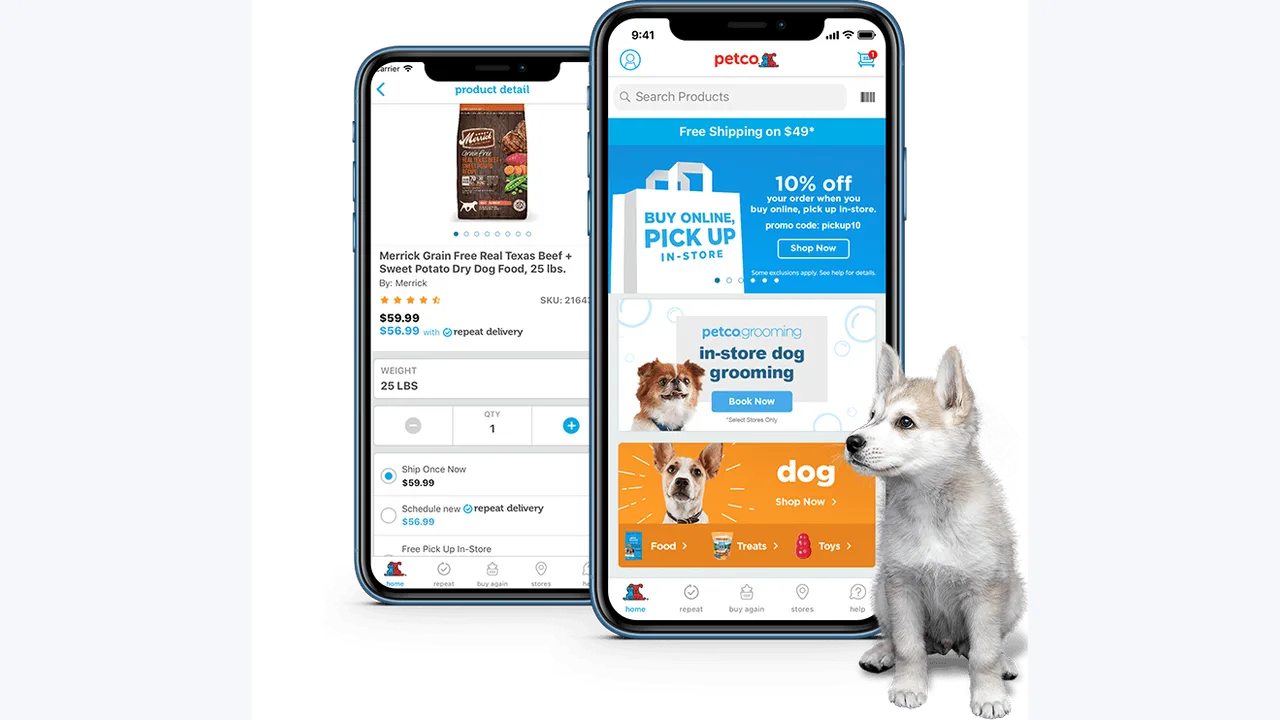
Cross-Platform Mobile Commerce for Petco
Challenge: After a year of development, Petco's mobile app was less than 25% complete.
Result: A team of five replaced a team of 50 and finished the app in four months on AWS serverless, cutting the timeline by 75%.
Read the Petco case study257%
Google Lighthouse score increase

Retail
Core Web Vitals Optimization for a Major Footwear Retailer
Challenge: The retailer's Angular e-commerce site scored about 7 on Google Lighthouse, which hurt its search rankings.
Result: Targeted code fixes raised the score to about 25 in four months, a 257% increase.
Read the footwear retailer case study"JBS feels more like an extension of our internal team than a traditional vendor relationship."
Senior IT Leader, AmeriVet Partners
TECHNOLOGY
Web and Mobile Technology
We choose the stack for the app and for the team that will run it. On the web, that's most often React and Next.js, with Python and Django or .NET behind them. On mobile, it's Flutter and React Native for cross-platform apps, and Swift and Kotlin for native ones.
Behind every app is an API layer. Web and mobile apps share it, so a business rule changes in one place.
FRONT ENDS
Web app
Shared APIs
Mobile app
BEHIND THE APIS
Business systems
ERP, CRM, and orders
Sign-in
Single sign-on
COST AND TIMELINE
What Drives App Development Cost and Timeline
App cost and timeline depend mostly on how many platforms you need and what the app connects to. Six factors drive most estimates:
- 01Platforms: web, iOS, Android, or all three
- 02Number of screens and workflows
- 03Integrations with existing systems
- 04Offline use and device features
- 05Accessibility, languages, and compliance
- 06App store releases and support after launch
How the timeline is set
The assessment sets the timeline. Because we ship in two-week sprints, working software reaches users early. As reference points, JBS Dev launched curbside pickup in a pet retailer's mobile app in six weeks, and a healthcare support services company's employee portal took about 16 to 20 weeks for its initial build.
How cost is set
We don't quote a number before we understand the work. The assessment turns the factors above into an estimate for each stage. If an off-the-shelf app or a low-code tool would do the job, we'll tell you.
ENGAGEMENT MODELS
Ways to Work With Us
Each model stands alone or leads into the next. Compare all the ways to work with us.
Assessment & Strategy
For companies that need clarity before committing to a build.
Start here if you're not sure what to change first. We review the system component by component, weigh difficulty against business impact, and recommend a path for each part, including what to leave alone. You get a roadmap you can act on with us or on your own.
- Technical assessment
- Architecture review
- AI opportunity mapping
- Modernization roadmap
- Prioritized recommendations
Best when: You need to understand the opportunity, risk, architecture, or roadmap before investing in a larger build.
Projects
For companies ready to build or modernize a defined system.
For a defined scope, senior engineers lead delivery from architecture through release. We work in stages, write tests for core components, and ship through CI/CD. You own everything we build, plus knowledge transfer and documentation tailored to your team.
- Modernization projects
- Custom applications
- Cloud platforms
- Data systems
- Integrations
- AI agents
Best when: You have a clear business problem, workflow, or platform that needs to be built, modernized, or connected.
Teaming / Managed Delivery
For companies that need experienced delivery capacity.
When you need more than a single project, services we can provide include architectural guidance for your existing team, hands-on development, QA, and ongoing support. Senior US-based engineers lead our builds, and nearshore support is an option for ongoing work.
- Senior-led teams
- Embedded engineering
- Ongoing development
- Knowledge transfer
- Flexible support
Best when: You need reliable engineering capacity, technical leadership, or ongoing delivery support without adding unnecessary management overhead.
Project stalled with another vendor? Software Project Rescue
WHY JBS DEV
How to Choose a Mobile App Development Company
Enterprise mobile app development depends on the systems behind the app as much as on the screens. Here are five questions to ask, and how we answer them.
- Can they connect the app to our systems?
- Yes. We design the APIs first and connect apps to ERP, CRM, order, and identity systems.
- Who writes the code?
- Senior engineers. Engagements are led by senior engineers and technical leaders who can make architecture, integration, and security decisions directly. That means fewer handoffs, faster decisions, and the people you meet in the first call doing the work.
- Do they use the app the way your users will?
- They should. Our engineers use the software with realistic data before release, because a list that works with a few test records can fail with thousands.
- What happens after launch?
- Services we can provide after launch include application support and maintenance, bug fixes, app store updates, and new features. Your own team can take over instead, with knowledge transfer and documentation from us.
- Where is the team?
- Senior US-based engineers lead our builds, with nearshore support available for ongoing work.
JBS Dev is a senior-led custom software development company, founded in 1999, that builds, modernizes, and integrates enterprise systems around the technology clients already own.
FAQ
Web App Development FAQs
What do web app development services include?
They cover planning, design, building, testing, and support for software that runs in a browser, from customer portals to internal tools. Ours connect to the systems you already run, share APIs with your mobile apps, and come with knowledge transfer and documentation for your team.
Should we build a native app or a cross-platform app?
Cross-platform fits most business apps. Flutter or React Native ships one codebase to iOS and Android, so one team maintains it. Native Swift and Kotlin apps make sense when the app needs top performance or deep device features. Some needs are met by a progressive web app with no app store at all.
How long does it take to build a web or mobile app?
It depends on platforms, screens, and integrations, and the assessment sets the timeline. Because we ship in two-week sprints, users see working software early. JBS Dev launched curbside pickup in a pet retailer's mobile app in six weeks, and Moda Operandi's ecommerce site and mobile app launched in under six months.
How much does app development cost?
It depends on the platforms, the number of screens and workflows, integrations, offline needs, accessibility and compliance requirements, and support after launch. We don't quote a number before we understand the work. The assessment turns those factors into an estimate for each stage before you commit.
Can the app work offline?
Yes, when the work needs it. Mobile apps and progressive web apps can store data on the device and sync when the connection returns, so people keep working without a signal.
Can you rebuild our app without starting over?
Often, yes. We keep the parts that still work and replace what users touch first. For a footwear retailer with more than 500 stores, JBS Dev improved the existing Angular site page by page instead of rebuilding it in React, and its Google Lighthouse score rose from about 7 to about 25 in four months.
Do you build accessible apps?
Yes. We build to the accessibility standard your users and contracts require, and we design for the languages your users speak.
Who owns the code and the app?
You do. You own everything we build, including the code and the intellectual property. There's no license fee to keep using your own app, and your team can change it when the business changes. Knowledge transfer and documentation are services we can provide at handoff.
