Company Overview
A leading North American bulk liquids storage and logistics provider, founded more than 85 years ago, operates an extensive network of storage terminals serving refiners, chemical manufacturers, and industrial customers across the energy and chemicals sectors.
Core operations include bulk liquid storage across large tank-terminal facilities, product handling (heating, blending, custom configurations), product movement and inventory coordination for crude oil, refined products, chemicals, and other liquid cargo, and logistics across marine, pipeline, rail, truck, and intra-facility transfer workflows.
Like many long-established operators, the company had accumulated a mix of homegrown applications, legacy software, spreadsheets, paper forms, phone-based coordination, and terminal-specific processes. The systems were still supporting the business, but they made reporting, planning, customer coordination, inspection readiness, and future growth harder than necessary. Leadership needed visibility into which systems were critical, where technical debt created risk, and how to modernize without disrupting operations.
Executive Summary
JBS Dev started with a focused assessment of one aging terminal application supported by spreadsheets, manual calculations, and phone-and-email coordination. That assessment revealed the path forward and evolved into five distinct modernization projects. Through execution, trust, and proven results, JBS Dev modernized critical marine terminal applications, centralized tank and inspection management, built infrastructure ROI modeling tools, and standardized enterprise-wide product-movement workflows, replacing manual work with structured systems while preserving operational continuity and the business rules that kept terminals running.
info JBS Dev did not begin by recommending a large rip-and-replace program. The engagement began with a quick assessment of one aging terminal application and its supporting spreadsheets, phone calls, and manual coordination. That assessment led to the first modernization project. Success created trust. Trust led to four more projects.
What We Discovered
JBS Dev started with a focused assessment of the aging marine terminal application. During that assessment and through the early modernization work, the team uncovered a broader operational picture. What began as one application problem revealed seven interconnected modernization opportunities across the organization.
Aging Marine Terminal System
A critical on-premises .NET application managed voyages, crude deliveries, and product parcels at a Canadian offshore terminal. The system remained operational, but it was difficult to maintain, expand, and report from.
Fragmented Tank & Inspection Data
Tank specifications, engineering drawings, and inspection schedules were scattered across disconnected spreadsheets. This increased the risk of missed deadlines, inconsistent records, and compliance issues.
Manual Product-Movement Workflows
Product-movement requests across marine, rail, truck, and pipeline operations were handled through phone calls, emails, and paper forms. This created a significant "manual tax" for experienced employees.
Limited Capacity Planning Tools
Multimillion-dollar infrastructure decisions depended on slow, spreadsheet-heavy analysis that could take months. Leadership had no fast way to model different expansion scenarios.
Spreadsheet-Heavy Inventory Tracking
Terminal inventory, customer account balances, tank-capacity planning, and dock-capacity planning relied on manual calculations and reconciliation across multiple sources.
Disconnected Reporting
Operational data was spread across several systems with no centralized reporting layer. Leadership lacked a consolidated view of the information needed for strategic decisions.
Core Platform Dependencies — The Most Important Finding
The homegrown core operations platform contained years of terminal-specific business rules critical to daily operations. The assessment revealed this system should NOT be replaced. JBS Dev recommended preserving it while building new capabilities around it, establishing the guiding principle: "Modernize what creates value now. Preserve what still works. Replace only when the business case and transition plan are strong enough."
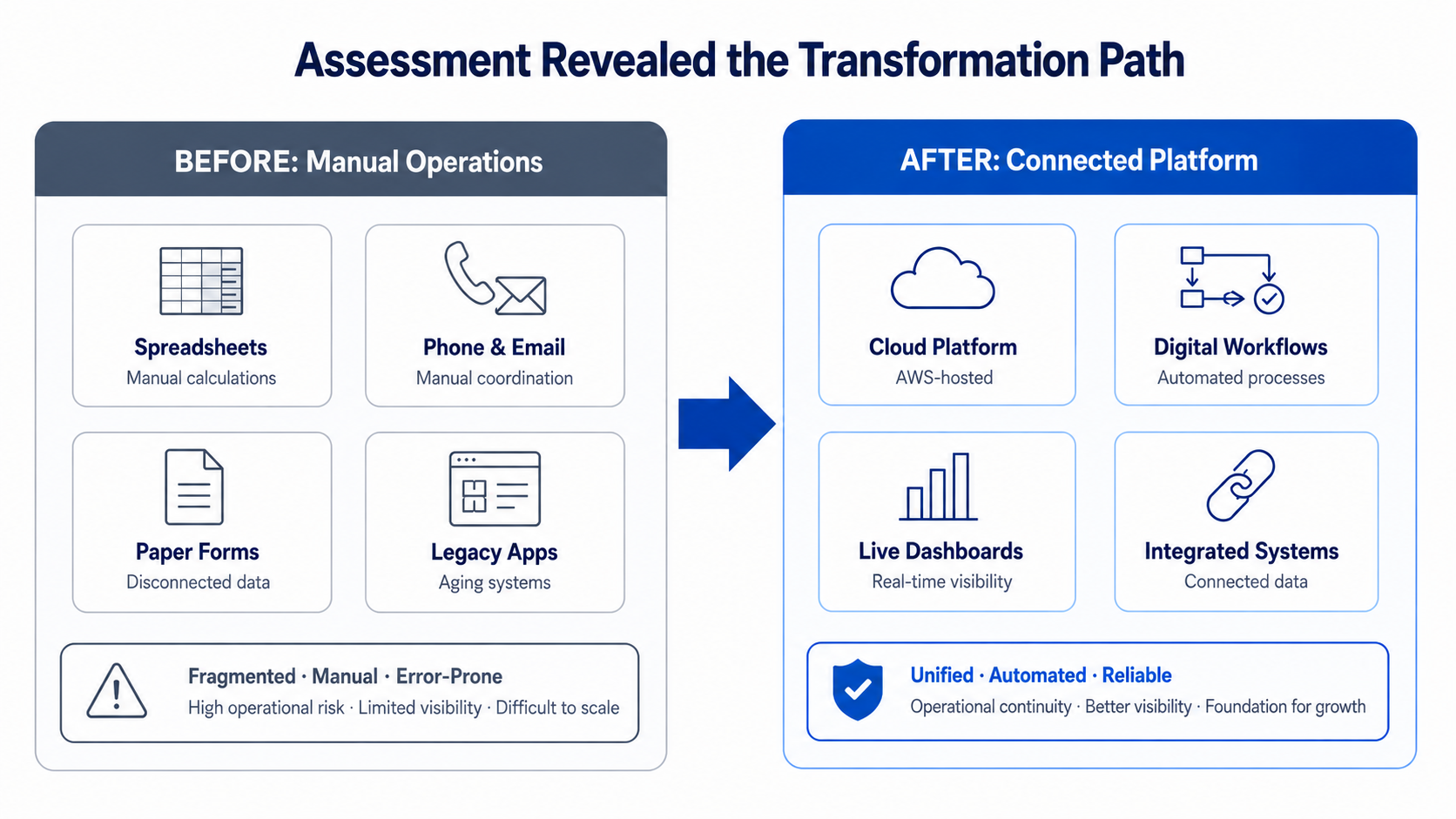
The assessment also revealed something equally important: which systems should NOT be replaced. The core operations platform contained years of terminal-specific business rules that would be dangerous to discard. JBS Dev recommended preserving it while building new capabilities around it, establishing the principle that guided every future project: Modernize what creates value now. Preserve what still works. Replace only when the business case and transition plan are strong enough.
✓ Addressed Assessment Finding #7: Core Platform Dependencies (strategic preservation decision)
The Modernization Journey
Each project created the trust, operational knowledge, and technical foundation for the next. This is the story of how one focused assessment evolved into five distinct modernization projects by replacing spreadsheets, manual coordination, and fragmented tools with connected operational systems.
The aging marine terminal application at a Canadian offshore facility was the highest operational risk. It managed incoming tanker voyages, crude deliveries and redeliveries, product parcels, and terminal logistics—workflows that couldn't stop during a lengthy rebuild.
The legacy on-premises .NET application worked, but it limited maintainability, reporting, future enhancements, and long-term reliability. More importantly, it contained terminal-specific business rules around voyage scheduling, tank availability, customer entitlements, and account balances that couldn't simply be discarded.
JBS Dev rebuilt the terminal application using Python and Django and moved it from the on-premises environment to AWS. Rather than copying the old interface, JBS Dev rebuilt the system around the business rules required to manage marine terminal activity. Tableau was added as the reporting layer.
The client retired the legacy on-premises application and moved critical terminal-operations workflows to a modern AWS-hosted platform. The new system provided more maintainable application foundation, centralized voyage and product-movement records, better operational reporting through Tableau, reduced dependence on scattered spreadsheets, preservation of terminal-specific business rules, and a platform that could support new capabilities without starting over.
✓ Solved Assessment Finding #1: Aging Marine Terminal System
✓ Solved Assessment Finding #6: Disconnected Reporting (via Tableau integration)
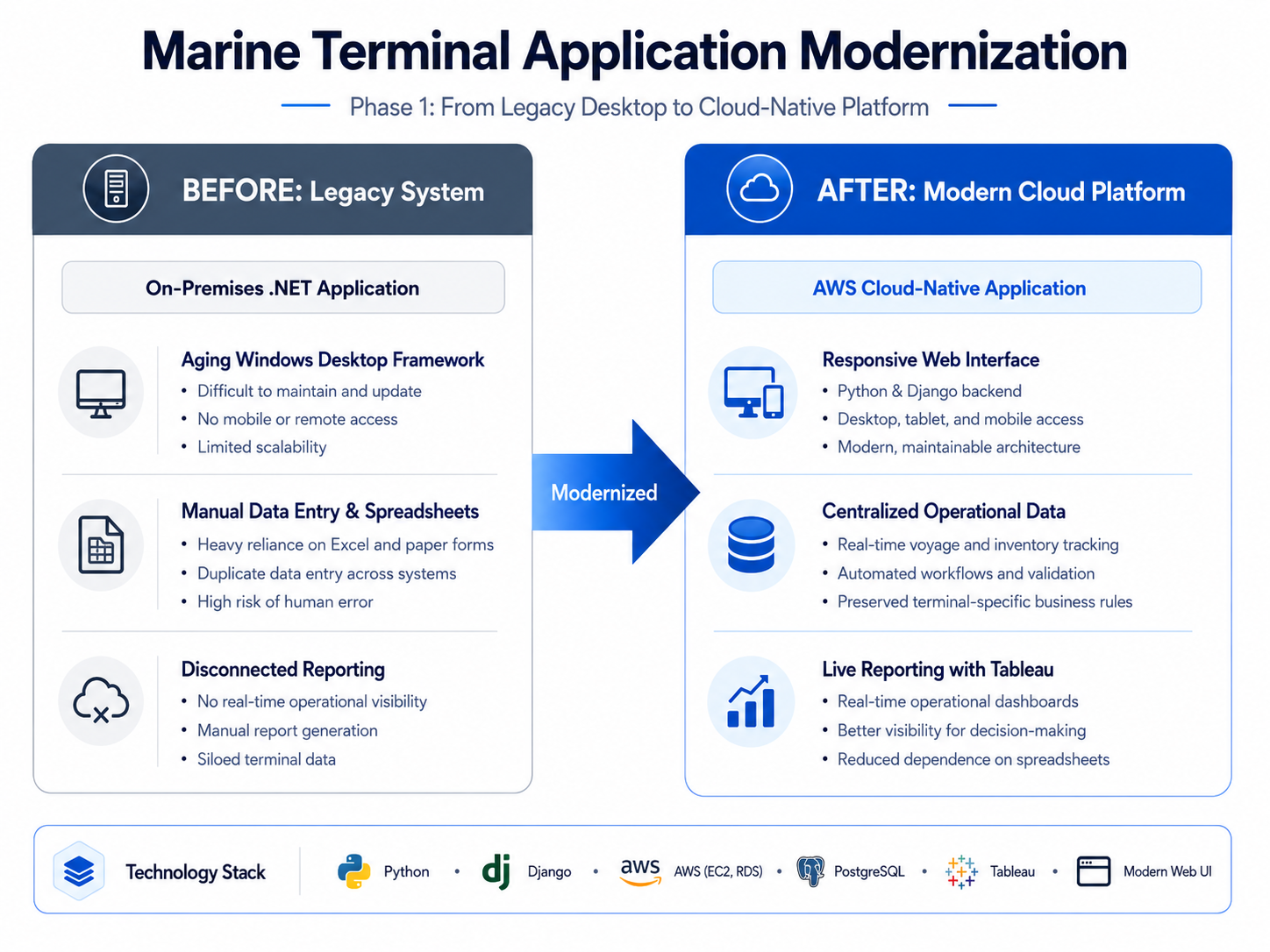
Marine terminal application modernization: from legacy desktop to cloud-native platform
The first version of the modernized terminal application focused primarily on voyage tracking. But the terminal also needed stronger capabilities for inventory visibility, customer account balances, tank-capacity planning, and dock-capacity planning.
These functions were partly dependent on spreadsheets, manual calculations, and disconnected workflows. Without a shared system, employees had to reconcile information across multiple sources and maintain complex operating logic outside the main application.
Rather than introducing another disconnected tool, JBS Dev expanded the same Python and Django application. The second phase added broader operational functionality, including terminal inventory tracking, customer account-balance management, tank-capacity planning, dock-capacity planning, and more robust operational visibility.
The terminal application evolved from a voyage-management tool into a broader terminal-operations platform. The expansion consolidated more workflows in one system, improved visibility into inventory and customer balances, supported better tank and dock planning, reduced reliance on separate spreadsheets and manual reconciliation, created reusable operational logic for future planning tools, and increased the value of the original modernization investment.
✓ Solved Assessment Finding #5: Spreadsheet-Heavy Inventory Tracking
After the terminal application had been modernized and expanded, leadership faced a major capital-planning question. The terminal wanted to evaluate how physical infrastructure changes could affect annual throughput and business capacity.
Leadership needed a faster way to ask: How much additional traffic could the terminal handle? Would a multimillion-dollar infrastructure investment generate enough additional business to justify its cost?
JBS Dev reused the operational and scheduling logic already built into the terminal application and made key physical and operational assumptions configurable. The modeling environment allowed the client to change parameters such as number of tanks, number of docks or piers, vessel traffic patterns, product-handling assumptions, and capacity constraints.
The project replaced a slow, spreadsheet-heavy planning exercise with a more dynamic scenario-modeling process. The client estimated that questions that might previously have required one or two months of spreadsheet work could be explored through a few weeks of modeling and collaboration.
✓ Solved Assessment Finding #4: Limited Capacity Planning Tools
The earlier projects focused primarily on product movement and terminal logistics. But the client also needed to manage the physical infrastructure that made those operations possible.
Across multiple facilities, important tank information was distributed across spreadsheets and disconnected records. Inspection planning was especially important, as external inspections had to be scheduled and prepared for, but spreadsheet-based tracking increased the risk of late preparation, inconsistent records, or missed deadlines.
JBS Dev built a centralized Storage Tank Engineering and Management platform using Python and Django. The platform connected with the client's core operations system and created a shared database for tank and facility information, including inspection-date tracking with advance email notifications (~30 days before external inspections).
The platform gave the client a centralized system of record for physical tank infrastructure. Qualitative results included reduced dependence on disconnected spreadsheets, better visibility into tank specifications and inspection schedules, more consistent facilities-management processes, earlier preparation for external inspections, improved ability to locate and understand physical tank assets, and a foundation for future maintenance and asset-management capabilities.
✓ Solved Assessment Finding #2: Fragmented Tank and Inspection Data
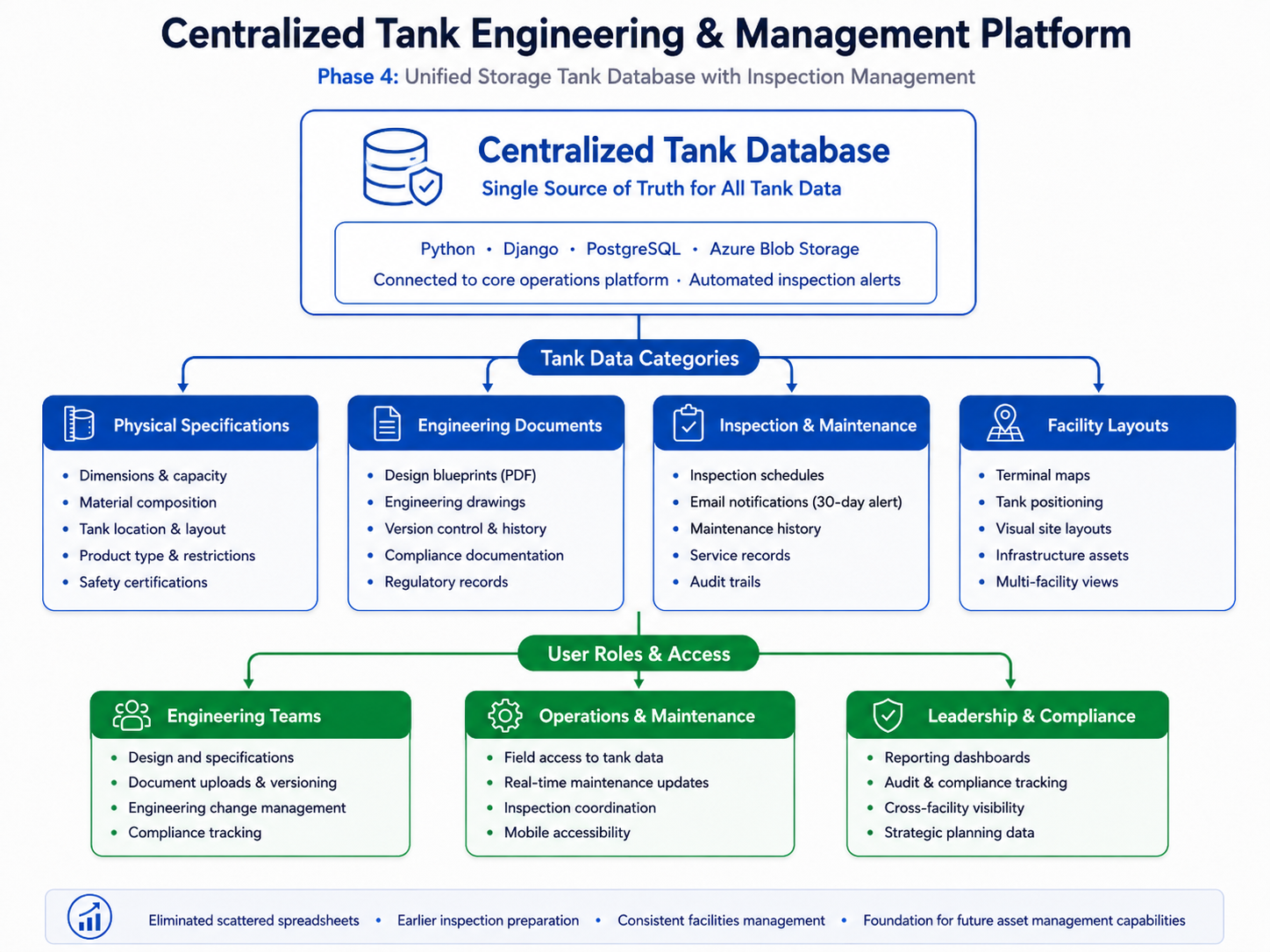
Centralized tank engineering platform with integrated inspection tracking
The client's next major challenge extended beyond one terminal. Customers leased tank capacity and needed to request the movement of product into, out of, or within terminal facilities through marine vessels, pipelines, rail, trucks, or intra-facility tank transfers.
Before the new platform, these requests were handled through highly manual processes involving phone calls, emails, paper forms, manual coordination, and re-entry of information across systems. This created what can be described as a "manual tax" because experienced employees spent substantial time coordinating information instead of focusing on higher-value operational work.
JBS Dev built an enterprise product-movement and customer request platform designed to allow structured digital submission of product-movement requests, connect each request to the relevant terminal and transportation method, support internal review and coordination, standardize workflows across facilities, create a system of record for requests and decisions, and allow customers to submit requests directly.
The platform reduced dependence on spreadsheets, paperwork, phone calls, and email coordination. It created more consistent product-movement workflows across terminals, better visibility into request status and operational decisions, fewer manual handoffs and duplicate data entry, lower risk of human error, and a stronger foundation for future integrations and automation.
✓ Solved Assessment Finding #3: Manual Product-Movement Workflows
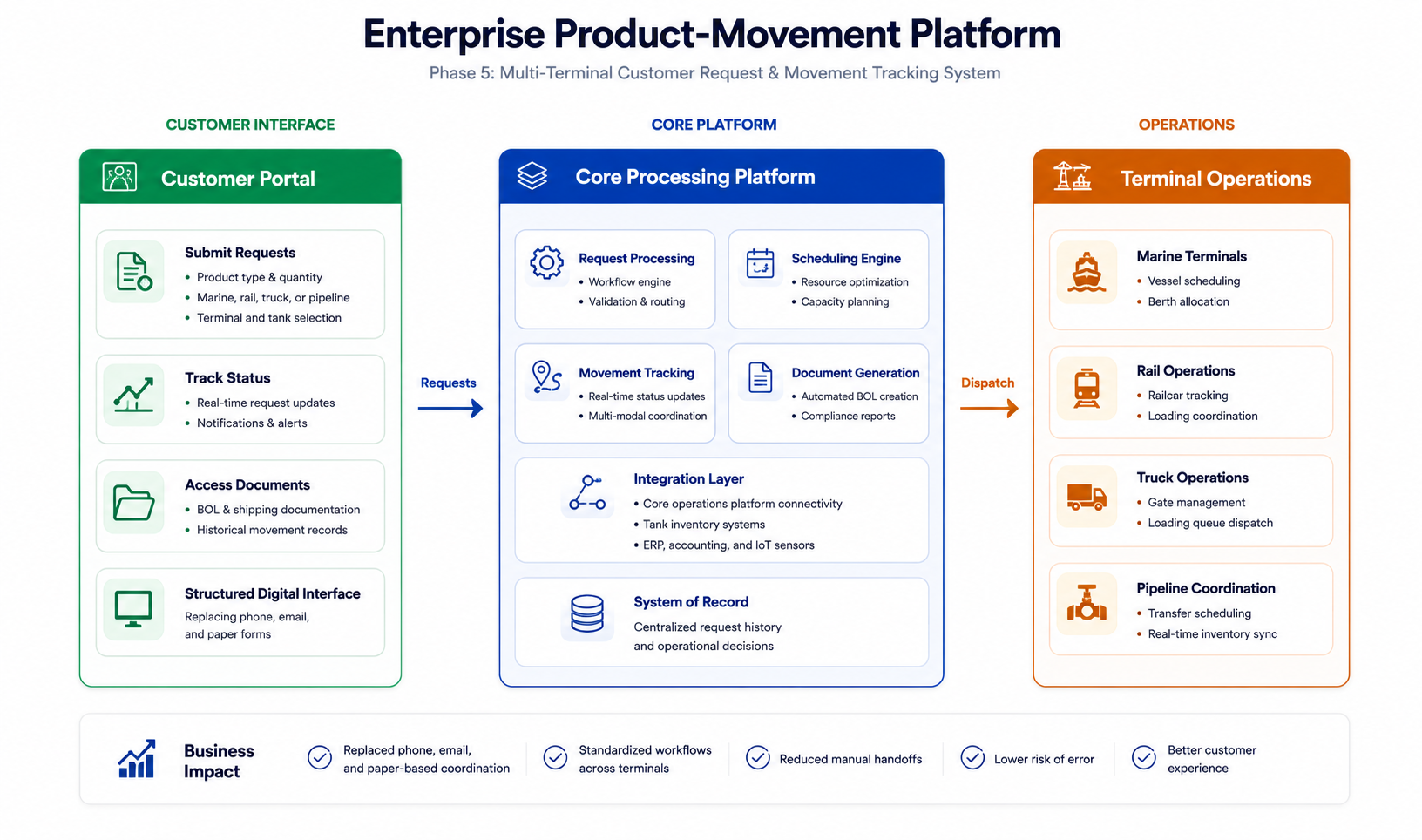
Enterprise product-movement platform coordinating marine, rail, truck, and pipeline workflows
Cumulative Business Value
Across the full relationship, JBS Dev helped transform fragmented operations into a connected platform, one practical project at a time.
Before: Fragmented Operations
After: Connected Operational Platform
verified The relationship also produced a less visible but equally important result: JBS Dev developed deep working knowledge of terminal operations, marine scheduling, tank management, product movement, and multi-modal logistics. That knowledge reduced the learning curve for each subsequent project.
What Made This Work
Assessment Created the Roadmap
JBS Dev began by understanding the technology environment, operational dependencies, and modernization risks rather than proposing immediate replacement. The assessment identified which systems were critical, which could be modernized, and which should be preserved, creating a practical sequence of work instead of a disruptive transformation program.
Phased Approach Eliminated Operational Risk
Each project was sequenced so it solved a meaningful problem without requiring enterprise-wide disruption. The client never faced a "big bang" implementation. Instead, they modernized one high-value workflow at a time, proved the value, then moved to the next, maintaining operational continuity throughout.
Preserved the Operational Knowledge
The value wasn't in the old programming language or interface. It was in the operating knowledge embedded in the systems. JBS Dev extracted and preserved terminal-specific workflows, scheduling logic, capacity assumptions, and customer-account rules rather than replacing technology blindly. This prevented costly operational mistakes and maintained institutional knowledge.
Platforms That Can Evolve
The terminal application supported later inventory features and capacity modeling. The tank platform created a foundation for future facilities-management capabilities. Rather than building isolated solutions, JBS Dev created platforms that could expand as operational needs grew, increasing the value of each modernization investment over time.
Stayed After Launch
JBS Dev continued supporting and refining the systems after launch. The same team that built the applications remained engaged for ongoing enhancements, issue resolution, and adaptation as operational needs changed. This continuity preserved knowledge, reduced risk, and demonstrated commitment to long-term success rather than treating delivery as the end of the engagement.
Client Owns the Systems
The applications are purpose-built for the client's operations. The client retains ownership rather than being forced into a per-seat or per-transaction licensing model for its own workflows. This reduces vendor lock-in, lowers long-term costs, and allows the systems to evolve around the business without recurring software subscription dependency.