
Company Overview
A self-funded PropTech startup founded by real estate practitioners and enterprise data engineers building AI-powered tools for residential real estate under a disciplined, product-led growth model. The B2B SaaS platform serves agents, listing coordinators, and brokerages. It analyzes property photos via computer vision to auto-generate MLS descriptions and structured data, cutting listing creation time from hours to minutes.
The challenge: agents spent hours on administrative tasks (writing descriptions, organizing photos, manual MLS data entry) instead of client work. Commission rule changes intensified pressure to maximize billable time. Before committing resources, the startup needed proof that AI could handle this work accurately enough for agent adoption and investor funding.
Executive Summary
JBS Dev built a 6-8 week POC proving computer vision and generative AI could analyze property photos and generate marketing-ready descriptions. Success validated technical feasibility and business value. That proof led to production agent workflows with batch processing. MLS integration via Chrome extension solved legacy system constraints. Consumer discovery platform extended capabilities to buyer-facing visual search. Ongoing support maintained platform stability through business growth.
The Trust-Building Progression
This engagement began as a small bet: a 6-8 week proof-of-concept validating whether AI could handle property description generation accurately enough for real estate agents to adopt. That POC proved technical feasibility and delivered immediate value.
Success created trust. Trust led to commitment. The client signed on for a full-blown application: production-ready agent workflows, pragmatic MLS integration, and eventually a complete consumer-facing discovery platform. What started as technical validation evolved into a multi-year, multi-phase engagement spanning five distinct platform expansions, each building on proven capabilities and deepening the partnership.
What The POC Revealed
The proof-of-concept validated AI accuracy and uncovered five interconnected opportunities that shaped the next four platform expansions.
AI Accurately Identified Property Features
Computer vision detected room types, architectural features, materials, and unique characteristics. AI-generated descriptions were marketing-ready with minimal editing.
Production Workflows Needed Beyond POC
Agent onboarding, batch processing, email notifications, and production infrastructure were missing. POC validated accuracy but wasn't ready for daily use.
Legacy MLS Systems Had No APIs
Regional MLS platforms required manual entry into hundreds of fields per listing. Even with AI-generated content, agents copied data field-by-field.
Buyer Search Was Text-Only
Traditional MLS limited buyers to bedrooms, price, and location. No visual search by design preferences, architectural features, or room characteristics.
Single-Sided Platform Missed Market Opportunity
Agent tools automated supply-side but ignored buyer experience. The same AI capabilities could power visual search and recommendations for buyers.
Ongoing Support Critical for Platform Stability
Production platforms require continuous maintenance, MLS compatibility updates, AI tuning, and proactive monitoring. Without dedicated support, reliability degrades and adoption stalls.
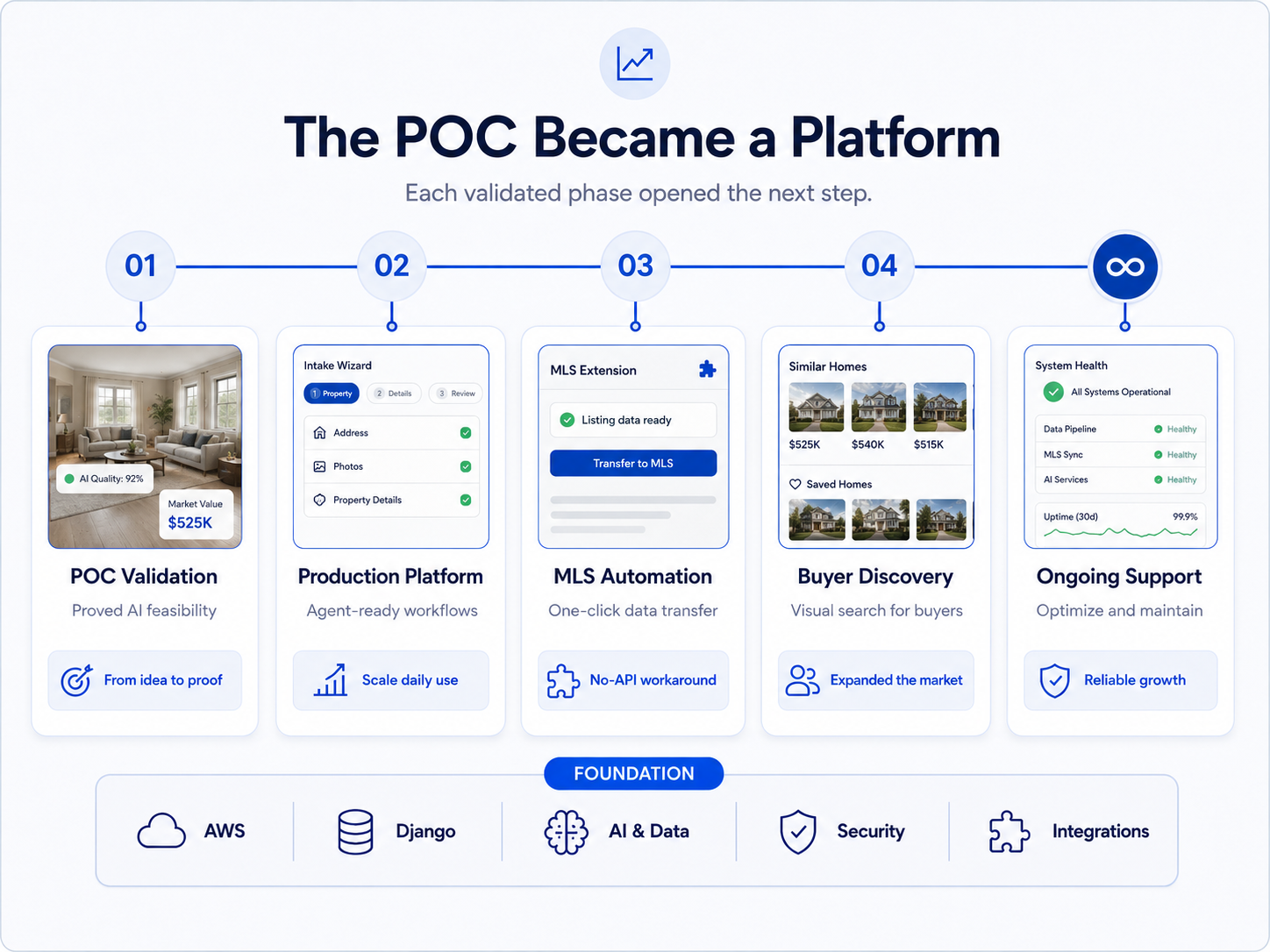
The Platform Development Journey
Each phase validated capabilities, created trust, and built the foundation for the next expansion.
The startup needed proof that AI could analyze property photos and generate marketing-quality descriptions before investing in full platform development. Agents spent hours on administrative tasks (writing descriptions, organizing photos, entering MLS data) instead of revenue-generating client work. Critical unknowns: Could AI accurately identify features? Would descriptions meet agent quality standards? Was the business model viable?
JBS Dev built a 6-8 week POC using AWS Bedrock, LangChain, Python, and Django on AWS Lambda with RDS PostgreSQL. Computer vision detected room types, architectural features, materials, and appliance details. Generative AI synthesized visual analysis with agent context to auto-generate descriptions. RAG architecture ensured compliance-safe language. The POC validated AI accuracy (descriptions were marketing-ready with minimal editing) and reduced writing time from 30+ minutes to under 5 minutes. Success led directly to production platform engagement.
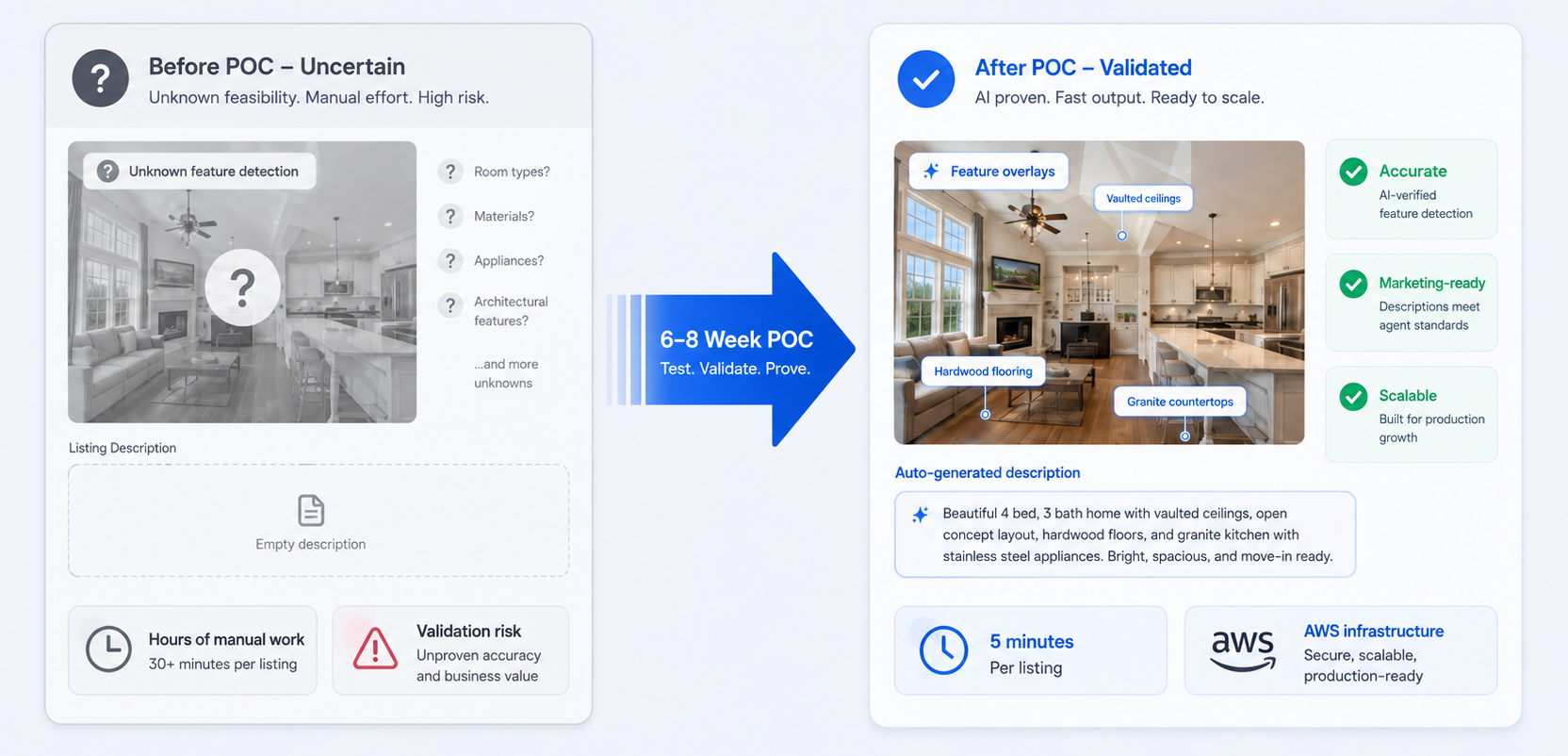
✓ Validated Finding #1: AI Accurately Identified Property Features
The POC proved technical feasibility but lacked production requirements: agent onboarding, batch processing, MLS-specific data capture, email notifications, and infrastructure supporting concurrent users. Without these workflows, the validated POC remained a demo, not a daily-use product.
JBS Dev built realtor intake wizard, MLS intake forms, customizable questionnaires, and image upload with AWS S3 integration. Asynchronous batch processing handled multiple images in parallel with automated resizing for LLM analysis. Production infrastructure included listing detail pages, AWS SES email notifications, user authentication, and mobile-responsive design. The platform scaled from POC to production supporting agent network growth with ongoing AI tuning improving accuracy.
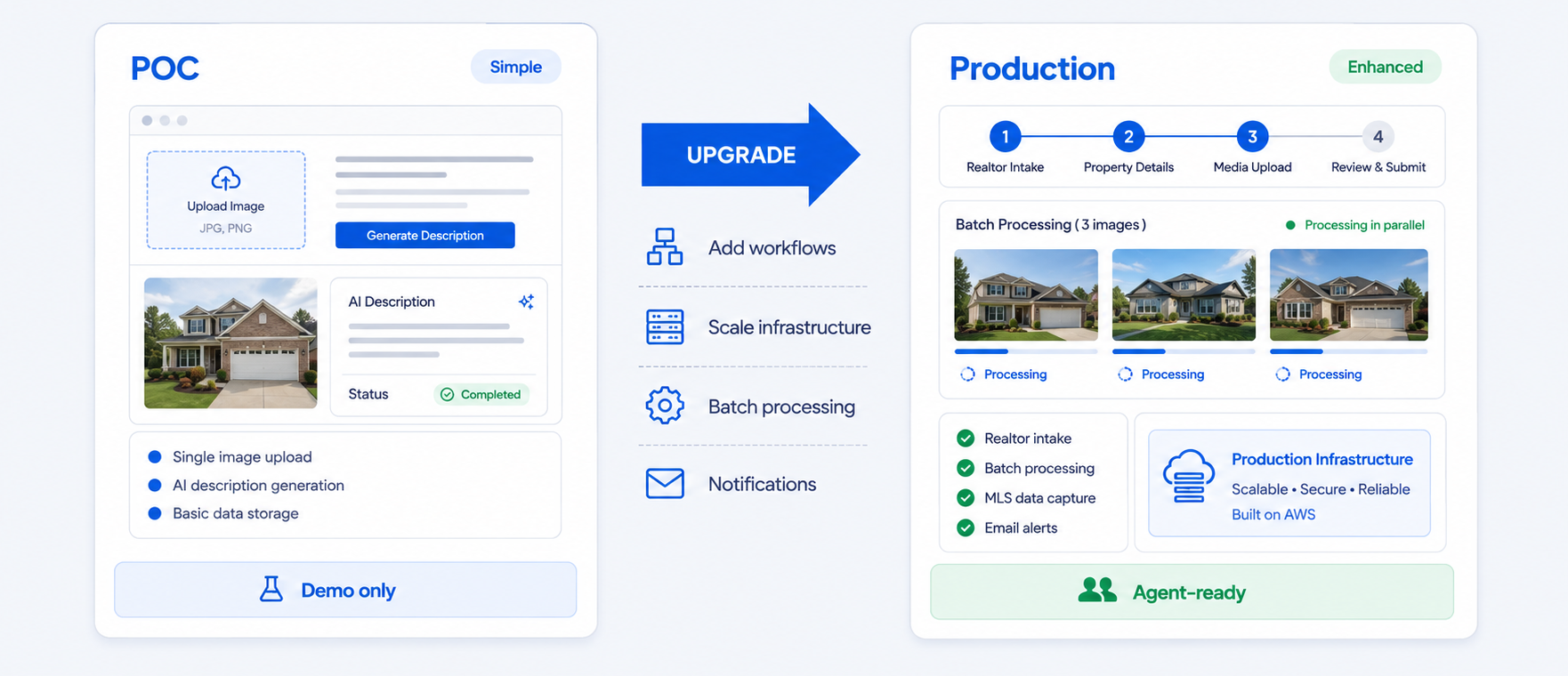
✓ Solved Finding #2: Production Workflows Needed Beyond POC
Regional MLS systems lacked APIs and required manual entry into hundreds of fields per listing. Even with AI-generated content, agents copied data field-by-field, eliminating time savings and reintroducing errors. Traditional integration (API, webhook, database sync) wasn't viable, and the solution needed to work across multiple MLS platforms (Procore, Cotality) without vendor cooperation.
JBS Dev explored three approaches and built a Chrome browser extension automating the complete workflow. The extension handled secure authentication (chrome.storage.local with optional logout), MLS platform detection, listing data retrieval from platform APIs, automated form and dropdown population with error handling, and direct photo upload with captions. Published to Chrome Web Store for easy installation, it reduced submission from hours to under 5 minutes. Listings now included comprehensive detail and metadata, making them more searchable than competitors' listings, all without requiring MLS vendor cooperation.
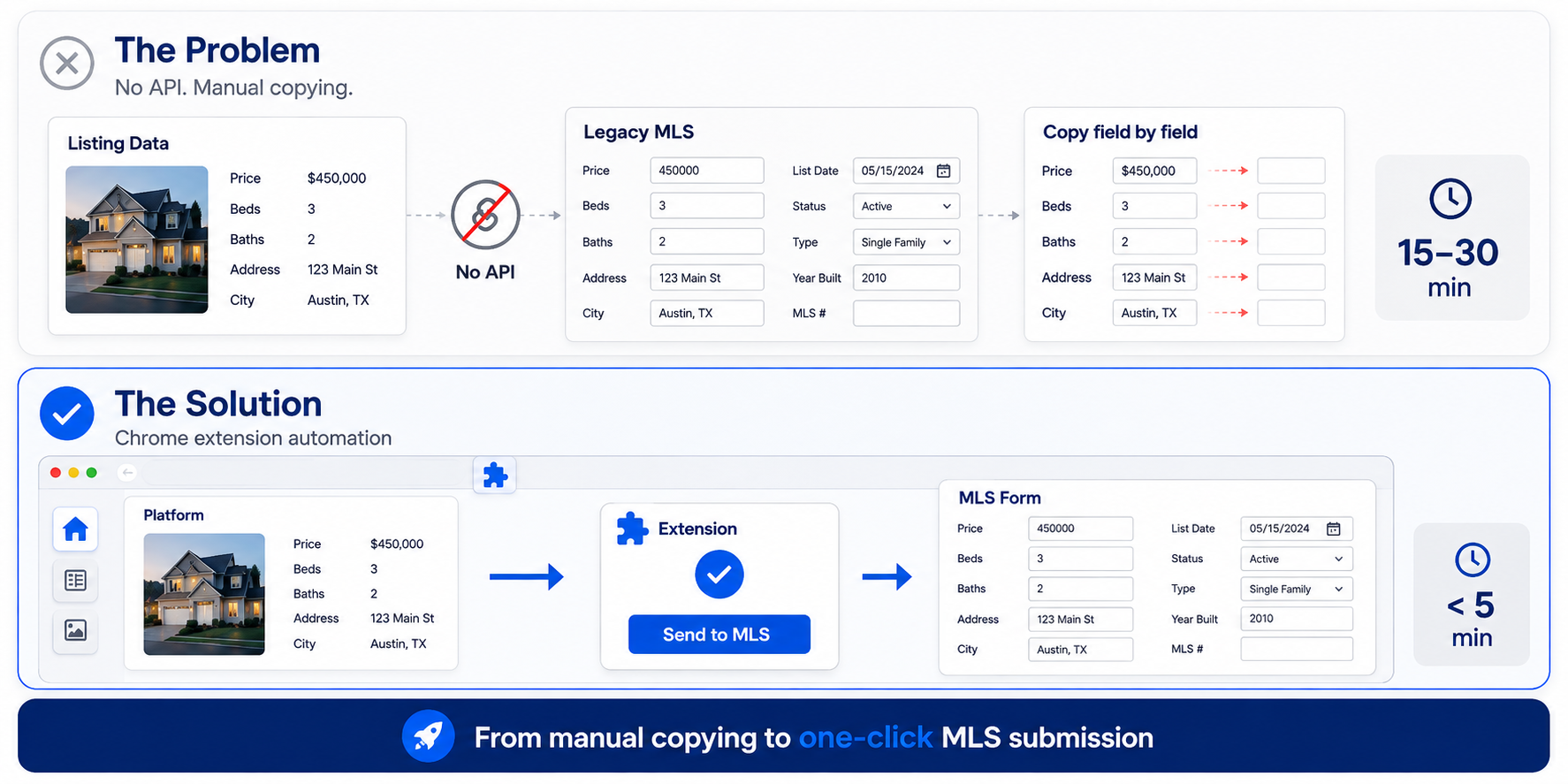
✓ Solved Finding #3: Legacy MLS Systems Had No APIs
Traditional MLS search limited buyers to text criteria (bedrooms, price, location) without visual discovery. Buyers couldn't find properties matching design preferences or architectural features. No tools existed for visual curation. Agents lacked visibility into buyer preferences beyond showings. The client remained single-sided, vulnerable to competitors offering end-to-end solutions.
JBS Dev built a consumer discovery platform with AI-powered visual search, comparable property finder, and intelligent recommendations. Integrated listings from RealEstateAPI with automated AI enrichment using the same computer vision from the agent platform. Features included classic criteria search across active/pending/sold properties, image-based visual search (upload photos or select rooms to find similar homes), user registration, "like" functionality, visual pinboard for curating room collections, and AI recommendation engine. Extended value from agent tools to buyer experience, positioning the client in both supply-side and demand-side markets while giving agents insight into buyer aesthetic preferences through engagement data.
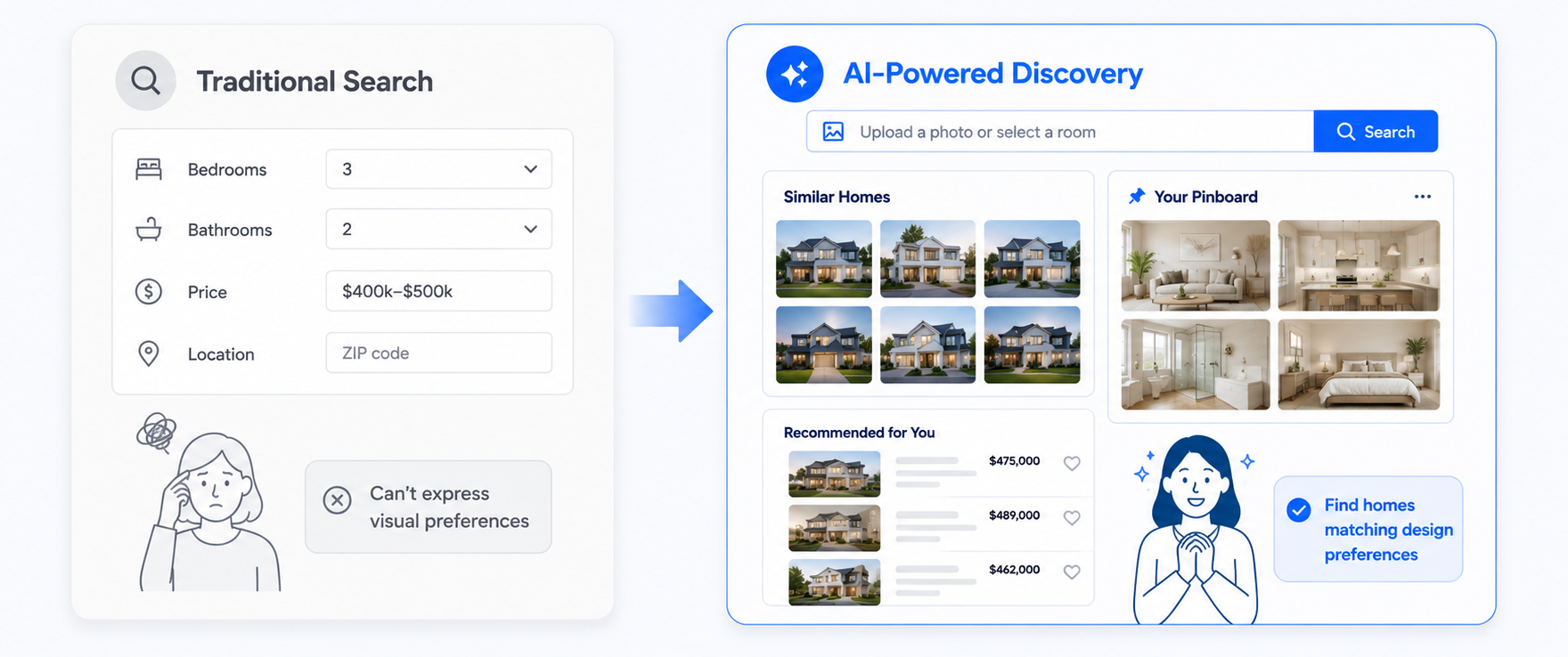
✓ Solved Finding #4: Buyer Search Was Text-Only
✓ Solved Finding #5: Single-Sided Platform Missed Market Opportunity
Production platforms require ongoing maintenance: rapid defect resolution, routine upkeep ensuring reliability, minor enhancements maintaining usability, technical guidance for future planning, proactive monitoring preventing user impact, and external API integration support.
JBS Dev provides dedicated support across the full suite (agent platform, Chrome extension, consumer discovery): identifying and resolving defects, performing routine maintenance, updating dependencies as AWS services/Chrome/external APIs evolve, adjusting AI parameters based on agent feedback, refining Chrome extension logic when MLS platforms change forms, enhancing search algorithms, providing roadmap recommendations, and supporting API integrations. High availability supported business growth. Rapid issue resolution prevented prolonged disruption. The client focused on growth and sales rather than technical firefighting.
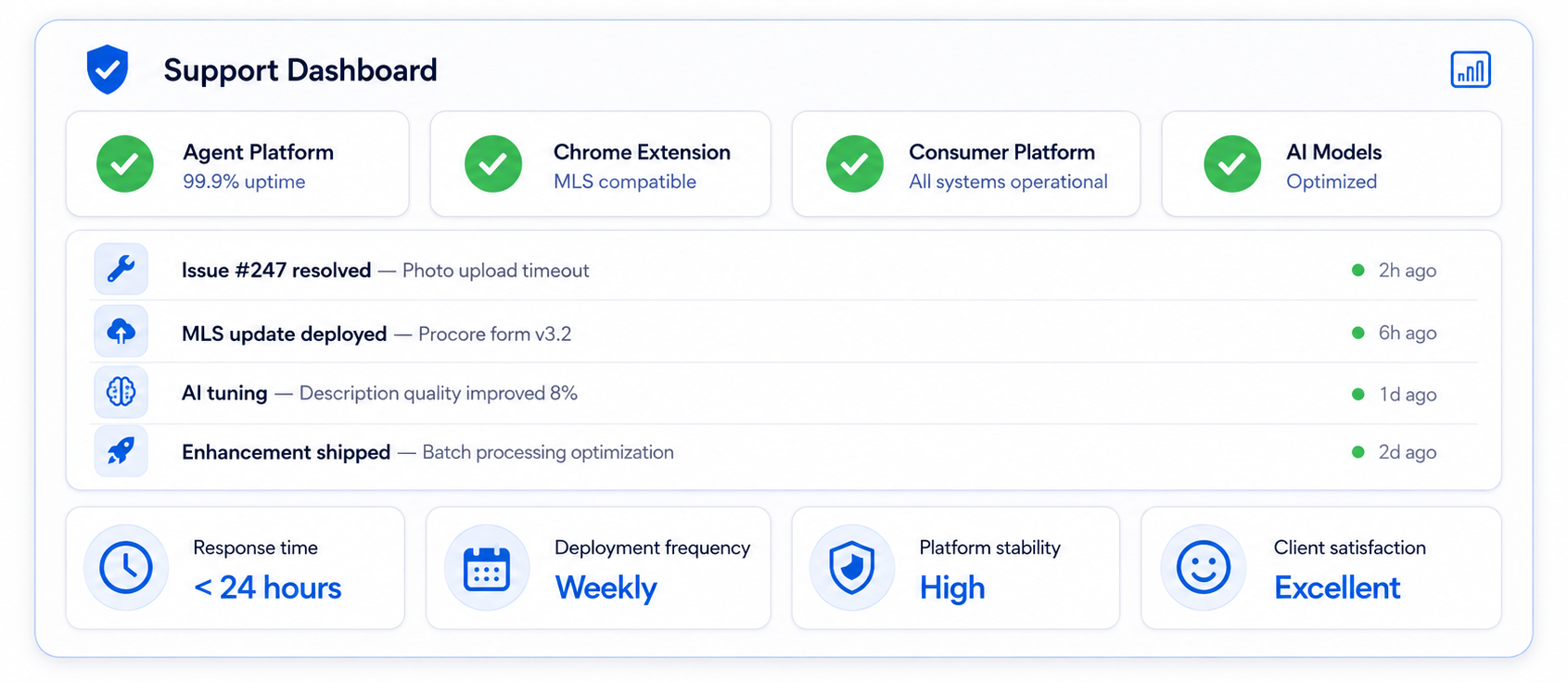
✓ Addressed Finding #6: Ongoing Support Critical for Platform Stability
Cumulative Business Value
From technical hypothesis to complete dual-sided platform, one practical validation at a time.
Before: Manual Workflows and Uncertain Feasibility
After: Validated Dual-Sided AI Platform
verified JBS Dev developed deep working knowledge of real estate workflows, MLS integration constraints, computer vision, generative AI, and visual search. This reduced learning curve for each subsequent project and enabled rapid response to evolving business needs.
What Made This Work
POC Validated Before Full Investment
A 6-8 week proof-of-concept demonstrated that AI could accurately analyze photos and generate marketing-quality descriptions before full platform commitment. The POC de-risked investment by proving technical feasibility, business value, and agent adoption potential, creating confidence rather than wasting resources on unvalidated assumptions.
Small Wins Built Long-Term Partnership
JBS Dev didn't propose a multi-year platform upfront. The engagement started with a minimal-commitment 6-8 week POC. That small bet proved value quickly without pressure. Success demonstrated capability and built trust. Each subsequent win earned the right to do bigger work: POC → production platform → MLS integration → consumer discovery → ongoing partnership. This incremental approach transformed a small engagement into a multi-year relationship through demonstrated results at every phase, not through salesmanship.
Pragmatic Solutions Over Ideal Architecture
When MLS systems lacked APIs, JBS Dev built a Chrome extension automating form population rather than waiting for vendor modernization. When listing data needed enrichment, existing computer vision capabilities were reused. Pragmatic engineering solved real-world constraints and delivered value despite legacy limitations.
AI That Respects Human Judgment
Rather than replacing agents, AI handled time-consuming analysis while agents maintained control over final outputs and client relationships. Positioning AI as a productivity tool—not a replacement threat—increased adoption. Agents trusted the system because they reviewed and refined outputs rather than accepting fully automated decisions.
Serverless Architecture for Startup Economics
Serverless AWS architecture (Lambda, RDS, S3, Bedrock, SES) charged only for actual usage rather than upfront infrastructure investment. This aligned with the client's self-funded growth model while supporting scalability from POC through production serving agent networks and buyer traffic. Costs scaled with business growth, not capacity planning.
Stayed After Launch
The same team that built the applications remained engaged for ongoing enhancements, issue resolution, MLS compatibility updates, AI tuning, and external API support. This continuity preserved knowledge, reduced risk, and demonstrated commitment to long-term success rather than treating delivery as the engagement end.