
Company Overview
The client is a major value-added distributor and manufacturer of industrial rubber, fluid power, and automation products across North America. With an expansive portfolio spanning hydraulic hoses, conveyor belts, gaskets, seals, and pneumatic systems, they serve clients across dozens of brands and multiple regions.
For years, they managed inventory operations through a Microsoft Access database housed on a virtual machine server. However, a previous consultant's attempt to modernize the system left them with an overly complex architecture that failed to meet operational needs or long-term maintainability goals.
Executive Summary
JBS Dev simplified an overly complex inventory system by rebuilding it with Microsoft Fabric and Azure SQL Server, delivering a maintainable architecture the internal team could manage independently—replacing consultant dependency with self-service Power BI reporting and long-term ownership.
info The system worked, but it had become a barrier to growth—outdated, unreliable, and impossible for the internal team to manage independently.
Business Challenge
Fragmented data architecture trapped inside legacy Access databases and overly complex pipelines—slowing reporting, creating maintenance nightmares, and limiting scalability.
Operational Efficiency:
- Manual data reconciliation across fragmented systems
- Slow report generation delaying operational insights
- Limited visibility into inventory and performance
- Technical debt blocking new feature development
Team Productivity:
- Internal team dependent on external consultants
- Hours spent troubleshooting unclear architecture
- Inability to build reports independently
- Training new team members difficult due to complexity
Business Risk:
- Unreliable Access database creating continuity concerns
- No disaster recovery or backup strategy
- Security vulnerabilities in outdated infrastructure
- Competitive disadvantage from slow reporting
Technical Debt:
- Overly complex architecture from previous consultant
- No clear path to internal ownership
- Fragmented data across Access, Excel, and SQL
- Limited scalability preventing business expansion
JBS Dev's Approach
Rather than add complexity, JBS Dev simplified the architecture and rebuilt the data platform using Microsoft Fabric, Azure SQL Server, and Power BI, creating a modern, cloud-native solution aligned with Microsoft's native capabilities.
The modernized platform delivers three core improvements:
1. Cloud-Native Azure Infrastructure
Migrated Access database to Azure SQL Server with secure storage and modern MVC web application replacing the legacy Access GUI
2. Microsoft Fabric Data Lakehouse (Bronze → Silver → Gold)
Built repeatable data pipelines with automated ingestion, transformation, and semantic modeling
3. Internal Team Enablement and Ownership
Trained the company's team to manage the system independently with documentation and hands-on guidance
The platform is scalable, maintainable, and designed for long-term internal ownership, eliminating dependency on external consultants and providing a foundation for sustainable growth.
Additionally, JBS provided a dedicated full-time resource to Singer Industrial's team to accelerate Gold layer development, data modeling, and Power BI report creation—enabling faster delivery of business intelligence capabilities.
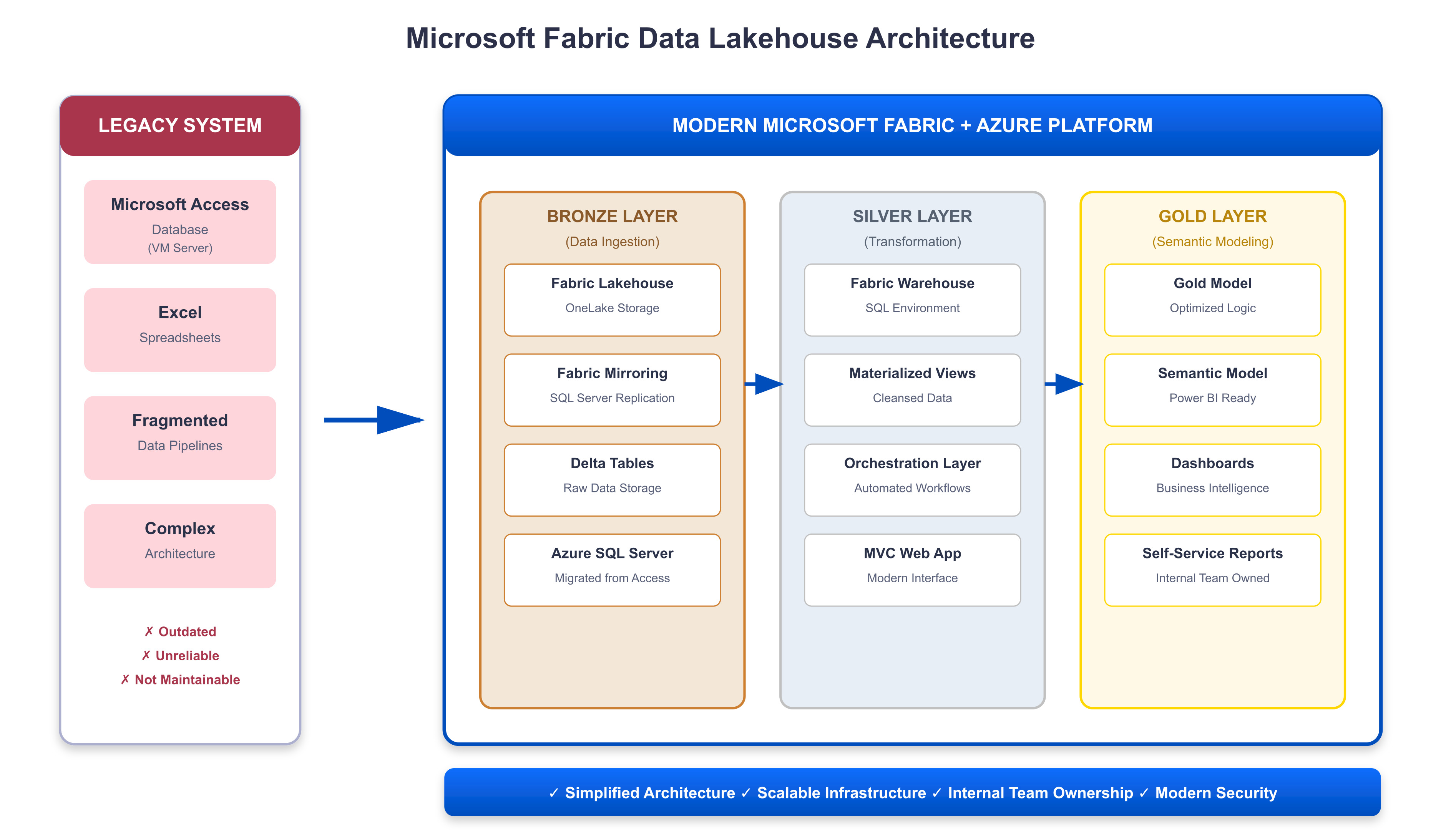
Microsoft Fabric Lakehouse replaces fragmented Access databases with unified, cloud-native data pipelines
Business Outcomes
Before: Legacy System
After: Modern Platform
verified_user Simplification Without Disruption: By building on Microsoft Fabric's native capabilities and removing unnecessary architectural complexity, JBS Dev delivered a system the internal team could understand, maintain, and extend.
What Made This Work
Simplified Architecture Over Added Complexity
JBS Dev removed unnecessary layers and rebuilt the platform using Microsoft Fabric's native capabilities, creating a system easier to understand, maintain, and extend.
Built for Internal Team Ownership from Day One
Rather than create dependency on external resources, JBS Dev trained the client's team at each phase with live demonstrations and Q&A sessions, ensuring knowledge transfer throughout Bronze, Silver, and Gold layer development.
Microsoft Fabric Lakehouse for Unified Data Pipelines
The Bronze → Silver → Gold architecture provides a clear, repeatable pattern for ingesting, transforming, and modeling data that scales with business needs.
Cloud-Native Azure Infrastructure for Scalability
Migrating from on-premises Access to Azure SQL Server and Microsoft Fabric eliminated infrastructure limitations, offering modern security, scalability, and disaster recovery.
Repeatable Processes Enable Rapid Feature Development
By documenting repeatable processes for adding datasets, building reports, and integrating data sources, JBS Dev empowered the team to extend the platform at business speed.