
Company Overview
The client is a premier U.S. luxury floral boutique and tech-driven e-commerce franchise operating physical storefronts that double as local fulfillment and production hubs. With approximately 95% of orders generated online, their business model combines direct-to-consumer e-commerce with physical brick-and-mortar production units.
The franchise model emphasizes local execution, marketing, and fulfillment supported by centralized technology and digital marketing partnerships. Physical locations average a compact 1,400 square feet positioned near residential neighborhoods to elevate local digital search visibility, with small teams of three to four employees per storefront.
The company's legacy e-commerce platform exhibited codebase sprawl, performance bottlenecks, and security vulnerabilities. Additionally, a large offshore team managed customer support operations slowly and at high cost with limited visibility into resolution progress.
Executive Summary
JBS Dev delivered a comprehensive technology transformation for a national luxury florist and e-commerce franchise through selective platform modernization and AI-powered support automation—achieving 81% load time reduction, 34% conversion improvement, 156% mobile revenue growth, and autonomous resolution of 70-80% of support tickets while eliminating the offshore team and maintaining zero downtime.
info The platform worked, but technical debt limited feature velocity, security vulnerabilities created operational risk, and manual support operations consumed significant resources without scaling efficiently.
Business Challenge
Legacy technical debt, slow page loads, and high-cost manual support operations constrained the company's ability to scale franchise growth profitably.
Platform Performance and Technical Debt:
- Codebase sprawl: Poor separation of concerns making maintenance difficult
- Performance bottlenecks: Threading, database aggregation, inefficient indexing
- Security vulnerabilities: Front-end validation, RBAC, password policies
- Limited scalability: Inability to scale franchise operations efficiently
- Feature velocity constrained: Technical debt limiting new feature delivery
Support Operations:
- Dozens of daily tickets: Inventory mismatches, charging errors, bugs, payment issues
- High-cost offshore team: Slow support with limited visibility
- Slow resolution times: Manual context gathering across multiple systems
- Poor scalability: Support didn't scale with franchise growth
- No pattern recognition: Repetitive issues resolved manually every time
Delivery Process and Documentation:
- SDLC process gaps: Delivery methods and agile practices needed improvement
- Unclear team roles: Inconsistent planning and sprint practices
- Incomplete documentation: Difficult maintenance and onboarding
- Limited collaboration: Communication gaps across teams
JBS Dev's Approach
Rather than a risky "rip and replace" approach, JBS Dev delivered two connected initiatives addressing both platform stability and operational efficiency: selective platform modernization using AI-assisted development, and production AI-powered support automation using Claude + Model Context Protocol.
Initiative 1: AI-Assisted Platform Modernization
- Conducted comprehensive SDLC assessment identifying gaps in delivery practices, team organization, and quality assurance
- Used AI tools to document existing codebase, identify preservation versus rewrite decisions, and generate test coverage before refactoring
- Preserved: Admin panel, database schema, select API endpoints to reduce risk
- Refactored: API and Admin systems for performance and security improvements
- Rebuilt: Frontend with modern React for improved user experience and maintainability
- Complete website redesign based on Figma designs with mobile-responsive implementation
- Patched security vulnerabilities (front-end validation, RBAC, password policies, reset-token handling)
- Integrated specialized third-party tools for timesheets, inventory management, and operational workflows
- Created comprehensive technical documentation and established sustainable development practices
Initiative 2: Claude + MCP Support Automation
- Trigger: Agent monitors ticket queue and initiates diagnostic workflow when tickets arrive
- Context Gathering: Claude uses Model Context Protocol to query ticketing, code repository, database, inventory, fulfillment, and AWS CloudWatch logs—creating unified diagnostic view
- Diagnosis: AI evaluates intent, diagnoses root cause, proposes fix, and assesses confidence level
- Resolution or Escalation: Simple fixes executed automatically (inventory corrections, order adjustments, data reconciliation) while complex issues escalate to human with full diagnostic context
- Secure integration via MCP to existing tools—no custom platform required
- Human-in-the-loop design for autonomous resolution of straightforward issues and escalation of complex bugs, edge cases, and low-confidence diagnoses
The modernized platform uses Modern React, refactored API and Admin systems, optimized hosting architecture, AI-assisted development tools, third-party integrations, Claude (Anthropic), Model Context Protocol (MCP), AWS CloudWatch integration, and cloud-hosted infrastructure supporting 24/7 automated processing. Additionally, JBS Dev provided ongoing delivery management support and part-time weekly effort for defects, enhancements, and ad-hoc requests.
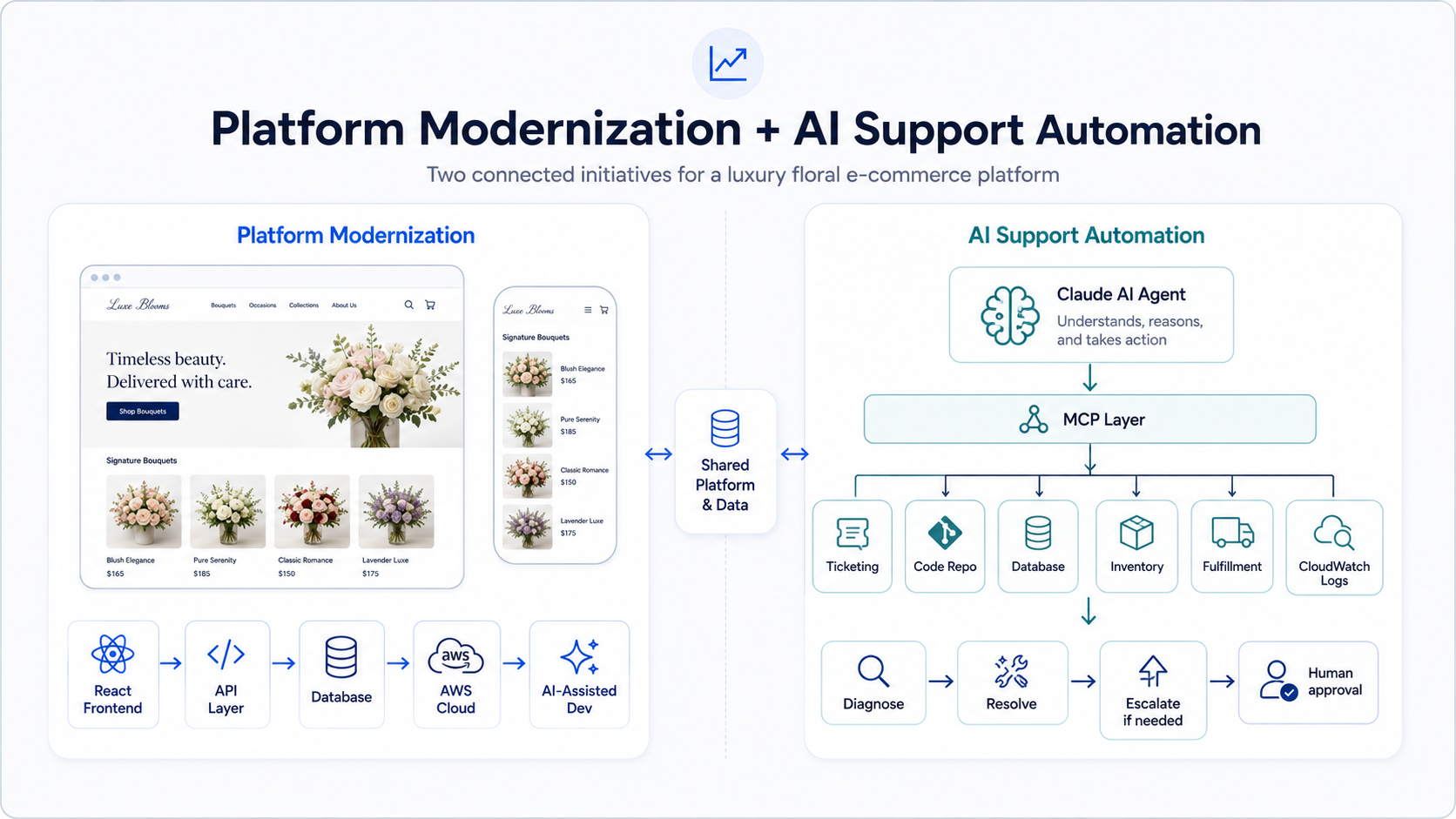
Selective modernization preserved proven components while AI-powered automation transformed support operations
Business Outcomes
Before: Legacy Platform and Manual Support
After: Modern Platform and Autonomous AI Support
verified_user Pragmatic Modernization and Production AI: By preserving proven components while selectively rebuilding performance-critical systems and deploying production Agentic AI with measurable ROI, JBS Dev delivered transformation without operational disruption.
What Made This Work
Selective Modernization Avoiding "Rip and Replace"
JBS Dev preserved the admin panel, database schema, and proven API endpoints while selectively rebuilding the frontend and refactoring performance-critical business logic—achieving transformation without risky full rewrites and maintaining zero downtime throughout transition.
AI-Assisted Development Accelerating Legacy Refactoring
JBS Dev leveraged AI tools to systematically document the existing legacy codebase, identify preservation versus rewrite decisions, generate comprehensive test coverage before code changes, and assist with migration planning—accelerating modernization timeline and reducing manual effort compared to traditional refactoring methods.
Production Agentic AI with Claude + Model Context Protocol
JBS Dev built production customer support automation using Claude (Anthropic's AI) and Model Context Protocol autonomously resolving 70-80% of tickets by connecting Claude to existing tools (ticketing, inventory, database, fulfillment, AWS logs) via MCP without requiring custom platform development—eliminating the offshore support team and transitioning to a lower-cost fractional model.
Human-in-the-Loop AI Design for Support Automation
JBS Dev designed support automation with clear autonomous resolution and human escalation boundaries. AI executes straightforward fixes (inventory corrections, order adjustments, routine system updates) automatically while escalating complex issues, edge cases, or low-confidence diagnoses to human review with complete diagnostic context already gathered—balancing operational efficiency with appropriate governance and quality controls.
SDLC Assessment and Process Improvement
JBS Dev conducted comprehensive SDLC assessment before technical modernization, identifying gaps in software delivery practices, agile methodologies, team organization, and quality assurance processes—addressing both technical debt and delivery process constraints to establish sustainable development practices supporting long-term platform maintenance and enhancement.
Performance Directly Impacting Conversion and Revenue
The 81% load time reduction and mobile experience improvements delivered measurable business impact with 34% conversion rate improvement and 156% mobile revenue growth in the first quarter—demonstrating how technical performance optimization translates directly into franchise profitability and growth.