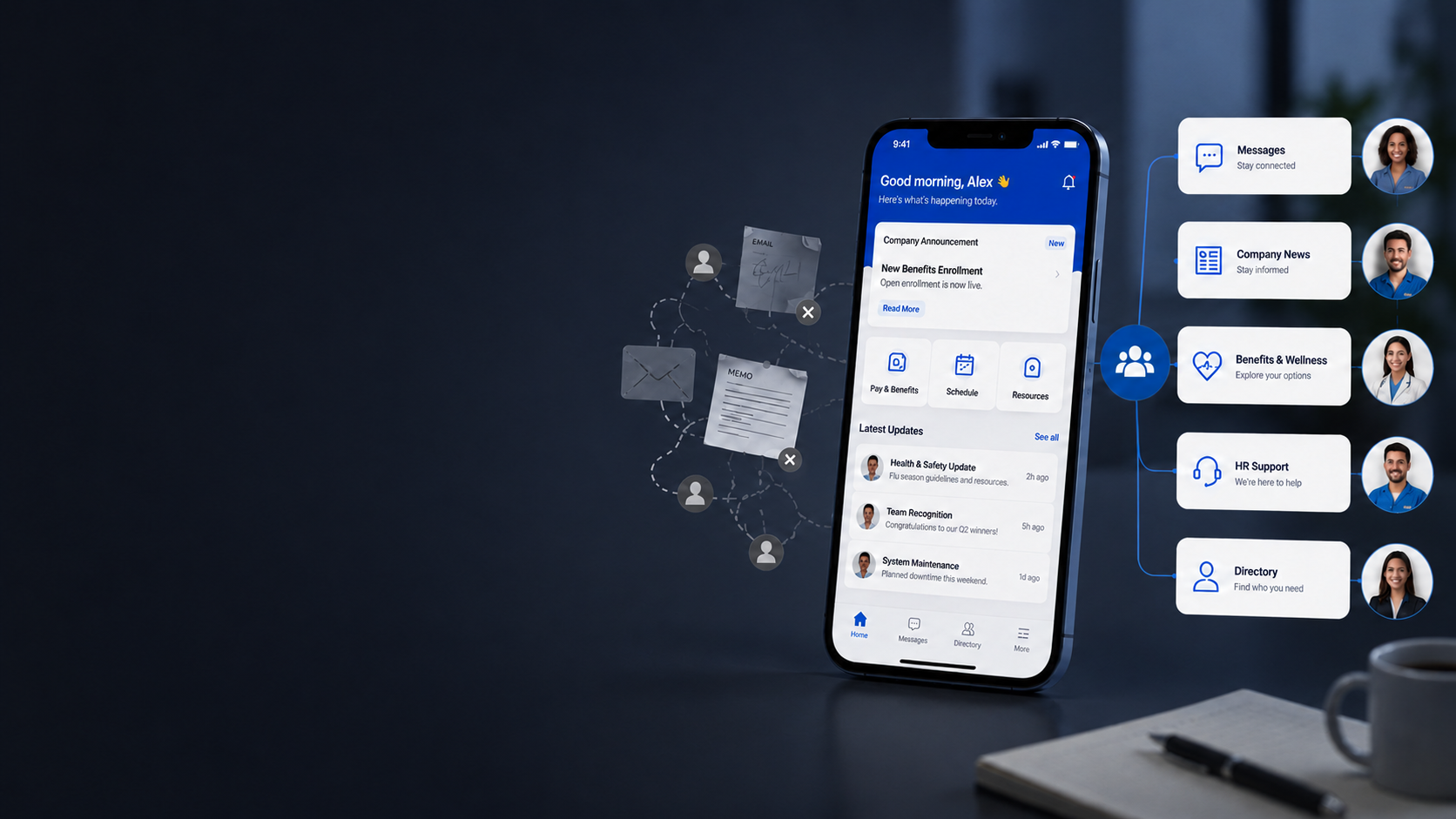
Company Overview
A private healthcare support services company founded in 1975 provides outsourced environmental, facilities, and housekeeping management for hospitals, aviation, education, government, and senior living sectors. With over 22,000 team members and $2.4 billion in annual revenue, they serve more than 750 clients across multiple industries.
Their workforce is highly distributed across geographies, industries, and service lines. Many are frontline, non-desk workers in environmental services (clinical cleaning, infection prevention), culinary operations, facilities management, and patient flow coordination. Most lack corporate email addresses.
The challenge: no centralized communication system to reach all employees. Leadership could not send targeted messages to specific roles, service lines, or locations. Employees had no unified hub for policies, training, or company announcements. Critical information was fragmented across disconnected channels with no tracking, no personalization, and no way to verify who received what.
Executive Summary
JBS Dev built an AI-powered employee portal serving 22,000+ non-desk healthcare workers through three enterprise applications: an employee communication platform with targeted messaging, multilingual video broadcasting, and AI-powered knowledge access; an agentic support automation platform processing 50,000+ annual tickets; and frontline kiosk consolidation unifying shared-device access. Built on AWS with Django, Next.js, Keycloak, and Bedrock RAG architecture.
One Platform Became Three Applications
This engagement began with a single objective: build a centralized employee communication platform for a distributed workforce. That platform proved its value through targeted communications, AI-powered knowledge access, and successful onboarding of 22,000+ employees without email dependency.
Success created trust. Trust led to expansion. The client returned with two additional operational challenges: automating 50,000+ annual support tickets through agentic workflows, and consolidating a legacy frontline kiosk into the unified platform. What started as workforce communications evolved into a comprehensive employee technology ecosystem spanning communications, automation, and frontline access.
The Core Workforce Technology Challenges
Initial discovery revealed four critical employee portal challenges and two broader operational automation opportunities that shaped the platform architecture.
No Centralized Communication System for Distributed Workforce
Leadership could not send targeted messages to specific roles, service lines, locations, or organizational hierarchies. Employees lacked a single source of truth for announcements, policies, or training. Critical information was fragmented across disconnected channels.
Frontline Employees Without Corporate Email Couldn't Be Reached
Thousands of non-desk workers lacked corporate email addresses. Traditional identity and access systems assumed email-based authentication. Onboarding hourly employees required custom account claim workflows, shared-device support, and manager-assisted recovery processes.
Policy and Procedure Access Required Repeated Support Tickets
Employees had no centralized knowledge hub. Routine policy questions generated support tickets. No AI-powered Q&A capability existed to provide instant, source-grounded answers to procedure, compliance, or operational questions.
Video Broadcasting Lacked Multilingual Support and Analytics
Leadership video content reached only English-speaking employees. No automated subtitle generation for 5-8 languages (Spanish, French, Creole, Somali, Tagalog, Nepali). No viewership tracking or compliance reporting for critical communications.
50,000+ Annual Support Tickets Consumed Manual Effort
Repetitive, rule-based support tasks (information lookups, access provisioning, routine system requests) required individual manual review, validation, and action. No automation framework existed. Each ticket consumed operational capacity that could be applied to higher-value work.
Fragmented Frontline Access Created Maintenance Overhead
Legacy Team Member Kiosk operated in separate Salesforce Sites environment with disconnected authentication (initials-and-ID model), separate content management, and no integration with employee portal. Maintaining multiple platforms increased support complexity and duplicated infrastructure.
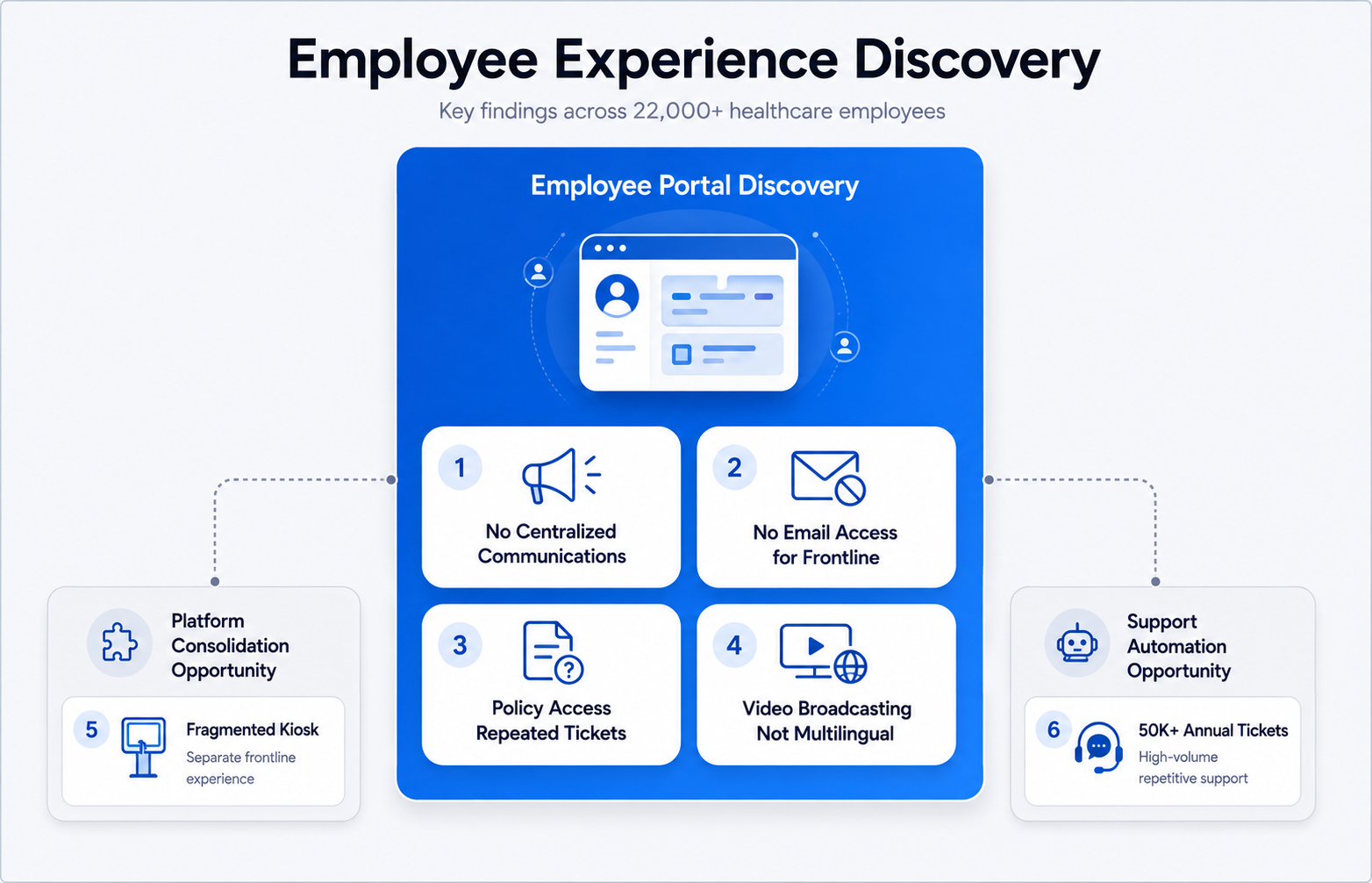
Assessment discovery diagram showing primary employee portal challenges and supporting operational opportunities
The Platform Development Journey
Each phase addressed specific operational challenges while building the foundation for subsequent platform expansions.
The company lacked a centralized system to reach 22,000+ employees across multiple geographies, service lines, and industries. Leadership could not target messages to specific employee segments (roles, locations, organizational hierarchies, business classifications). Employees had no unified hub for company announcements, priority communications, or important updates. Communications were fragmented with no viewership tracking, no personalization, and no single source of truth.
JBS Dev built a Python/Django and Next.js (React) Progressive Web Application with targeted leadership communications and content management. The CMS enabled creating, scheduling, and publishing announcements with audience targeting using Workday-derived employee attributes (role, service line, organizational hierarchy, business classification). Features included priority communications, personalized content feeds with audience-aware filtering, push notification support, administrative controls, approval workflows, and publishing oversight. Keycloak-based identity management integrated with Workday as the employee system of record, supporting employees with and without corporate email through custom account claim flows, password reset workflows, and manager-assisted onboarding. Role-based access control supported content creators, administrators, managers, and standard employees. Infrastructure built on AWS Lambda, Aurora PostgreSQL, S3, CloudFront, EventBridge, SQS, and deployed via AWS CDK with multi-environment strategy (Dev/Stage/Prod).
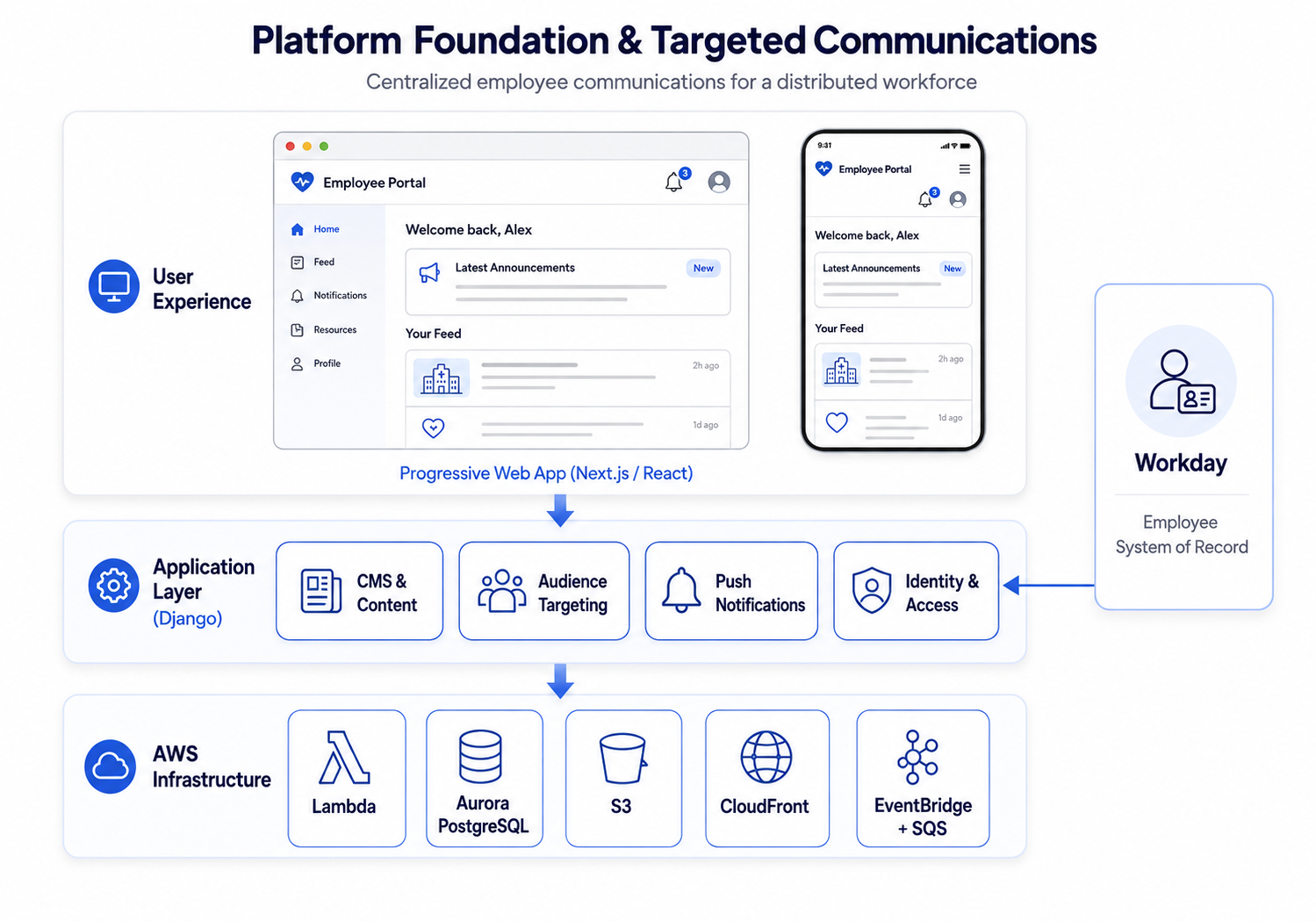
✓ Solved Finding #1: No Centralized Communication System for Distributed Workforce
✓ Solved Finding #2: Frontline Employees Without Corporate Email Couldn't Be Reached
Leadership video communications reached only English-speaking employees. Manual video processing and subtitle creation was time-consuming and error-prone. No automated multilingual support for diverse workforce (Spanish, French, Creole, Somali, Tagalog, Nepali). No viewership analytics to track video engagement, progress milestones, or completion events for compliance reporting. Video distribution coordination consumed administrative effort.
JBS Dev built an automated video processing pipeline with direct upload, AWS Elemental MediaConvert for adaptive bitrate HLS streaming, Amazon Transcribe for automated transcript generation, and Amazon Translate for multi-language subtitle support (5-8 languages including English, Spanish, French, Creole, Somali, Tagalog, Nepali). Video engagement analytics tracked viewership, completion rates, and progress milestones. Automated content moderation used Amazon Rekognition and Amazon Comprehend to prevent inappropriate content. Secure video delivery through CloudFront CDN with global content distribution. Administrators managed all content through Django Admin interface with no technical video expertise required. Videos viewable directly within portal with inline playback, optimized for mobile and varying network conditions.
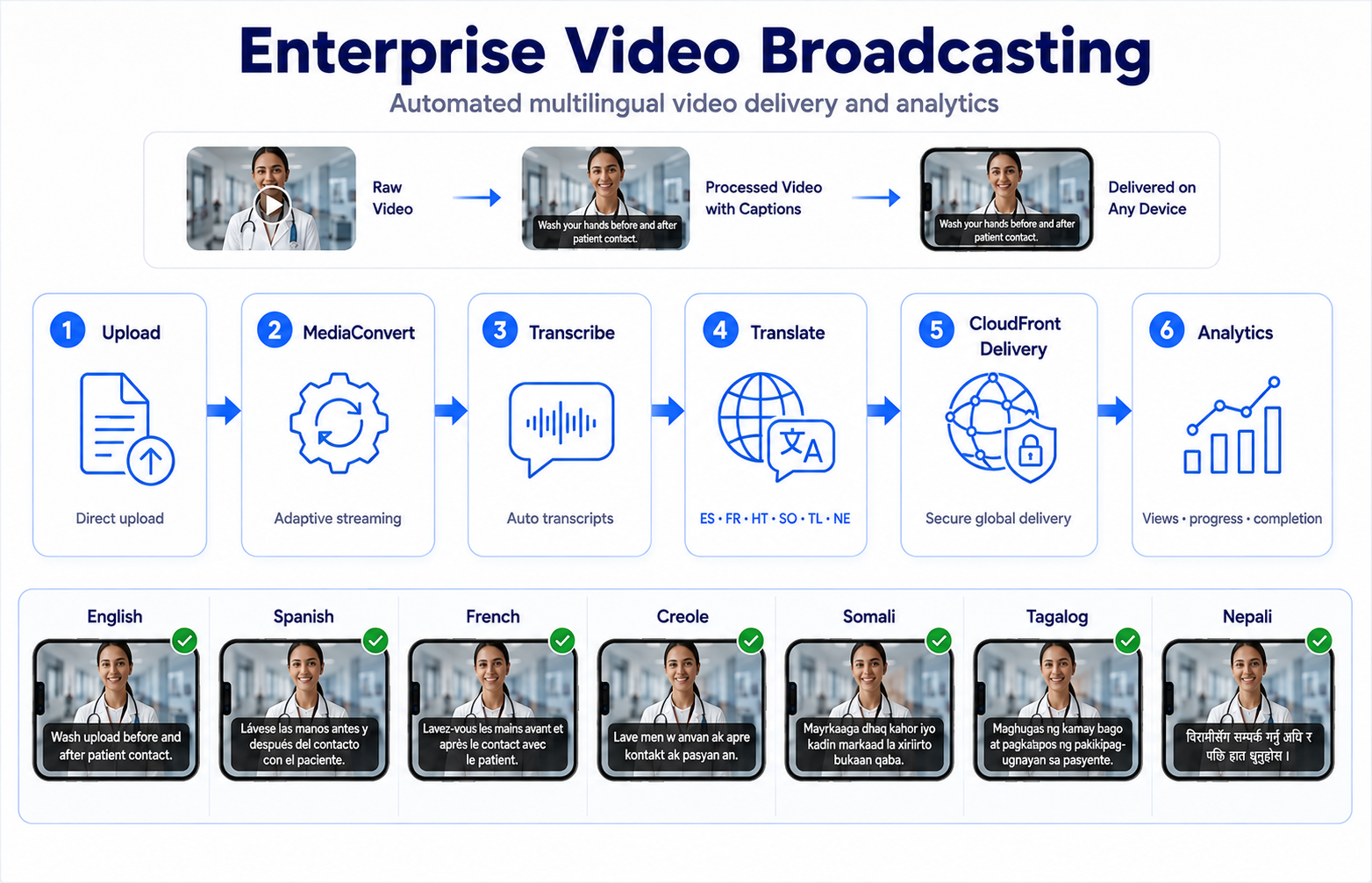
✓ Solved Finding #4: Video Broadcasting Lacked Multilingual Support and Analytics
Employees repeatedly contacted support for routine policy, procedure, and operational questions. No centralized knowledge hub provided instant access to company information. Manual policy searches were time-consuming. Support tickets consumed operational capacity on questions that could be self-served. No AI-powered capability existed to provide contextual, source-grounded answers to employee questions.
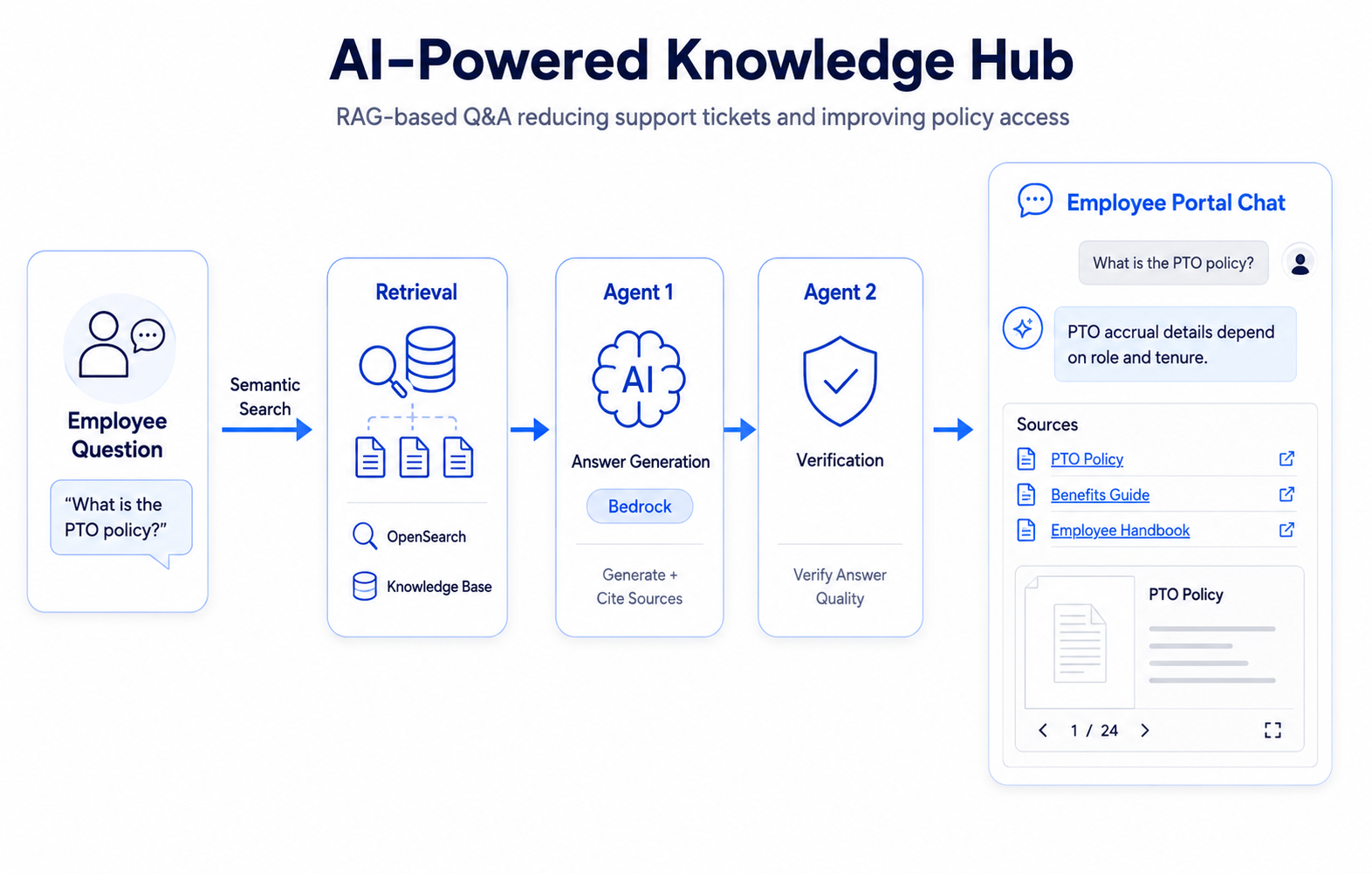
JBS Dev built an AI-powered Q&A Hub using Retrieval-Augmented Generation (RAG) architecture with AWS Bedrock Knowledge Bases and OpenSearch-powered content retrieval. Two-agent system included: (1) Retrieval & Answer Generation Agent selecting relevant document blocks and generating answers with source attribution and citation links, and (2) Answer Verification Agent evaluating whether the answer addressed the question. Employees asked natural-language questions about policies, procedures, and operational topics, receiving contextual answers grounded in organizational Knowledge Base documents. Documents and videos viewable directly within chat interface with inline playback. Standalone Document Library provided search for employees who preferred manual navigation. Self-service access reduced support ticket volume while ensuring consistent, accurate information delivery with full source traceability.
✓ Solved Finding #3: Policy and Procedure Access Required Repeated Support Tickets
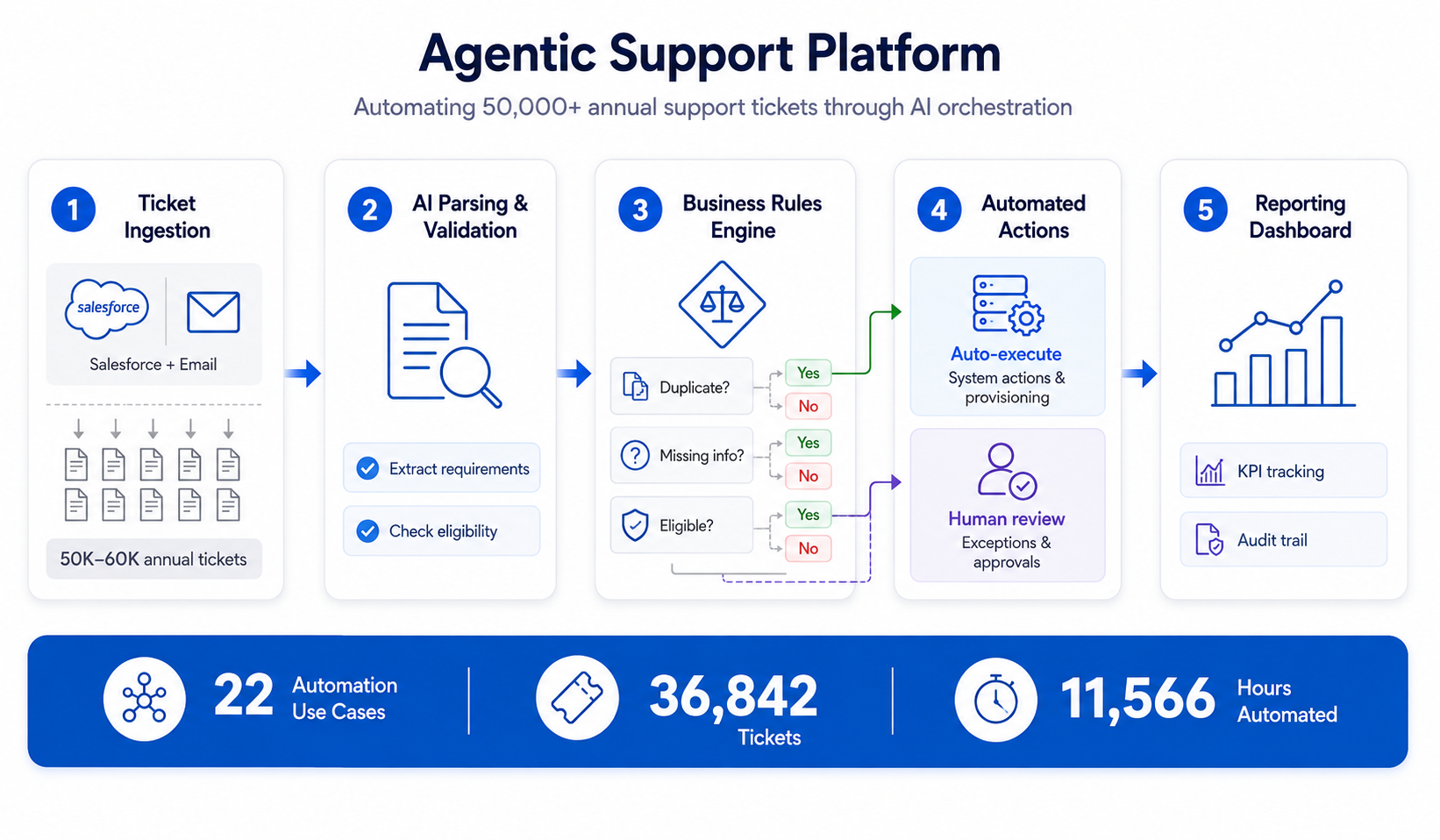
The company processed approximately 50,000-60,000 support tickets annually, many involving repetitive, rule-based tasks (information lookups, access provisioning, routine system requests). Manual processes consumed substantial operational capacity that could be better applied to higher-value work. Each ticket required individual review, validation, system lookups, provisioning actions, and manual updates across multiple systems. Common issues like duplicates, missing information, or eligibility problems were identified and resolved manually. No automation framework existed for future use cases. The organization lacked integration across multiple systems with proper auditability, governance, and error handling.
JBS Dev designed, developed, and deployed a foundational agentic automation platform within the client's AWS environment, structured in two phases: Phase 1 — Platform Foundation: Core agentic automation platform with AI orchestration layer, reusable workflow framework, ticket ingestion/parsing/orchestration, reusable integration patterns, business rules engine for validation and decisioning, operational controls (audit logging, error handling, governance), human-in-the-loop review for approvals and exceptions, and Salesforce-native reporting dashboards for operational visibility and KPI tracking. Phase 2 — Staples Access Automation (Initial Production Use Case): First production-ready automation workflow for Staples access provisioning requests, including automated ticket ingestion, parsing, validation of purchasing and eligibility requirements, identification and handling of common issues (duplicates, missing PCs), automated provisioning actions in Staples administrative environment, and human-in-the-loop review for approvals and governance control. Ongoing Expansion: The success led to dedicated expansion across three areas: (1) Help Ticket Automation Expansion systematically working through 22 identified automation use cases spanning payroll, HR, IT service desk, finance, vendor operations, and recognition programs (representing approximately 36,842 tickets and 11,566 hands-on hours annually); (2) Corporate Office Efficiency Automations expanding beyond support tickets to automate repetitive administrative workflows across corporate teams and executive functions; (3) Complex Bespoke Automations designing advanced workflows requiring sophisticated business logic and multi-system orchestration.
✓ Solved Finding #5: 50,000+ Annual Support Tickets Consumed Manual Effort
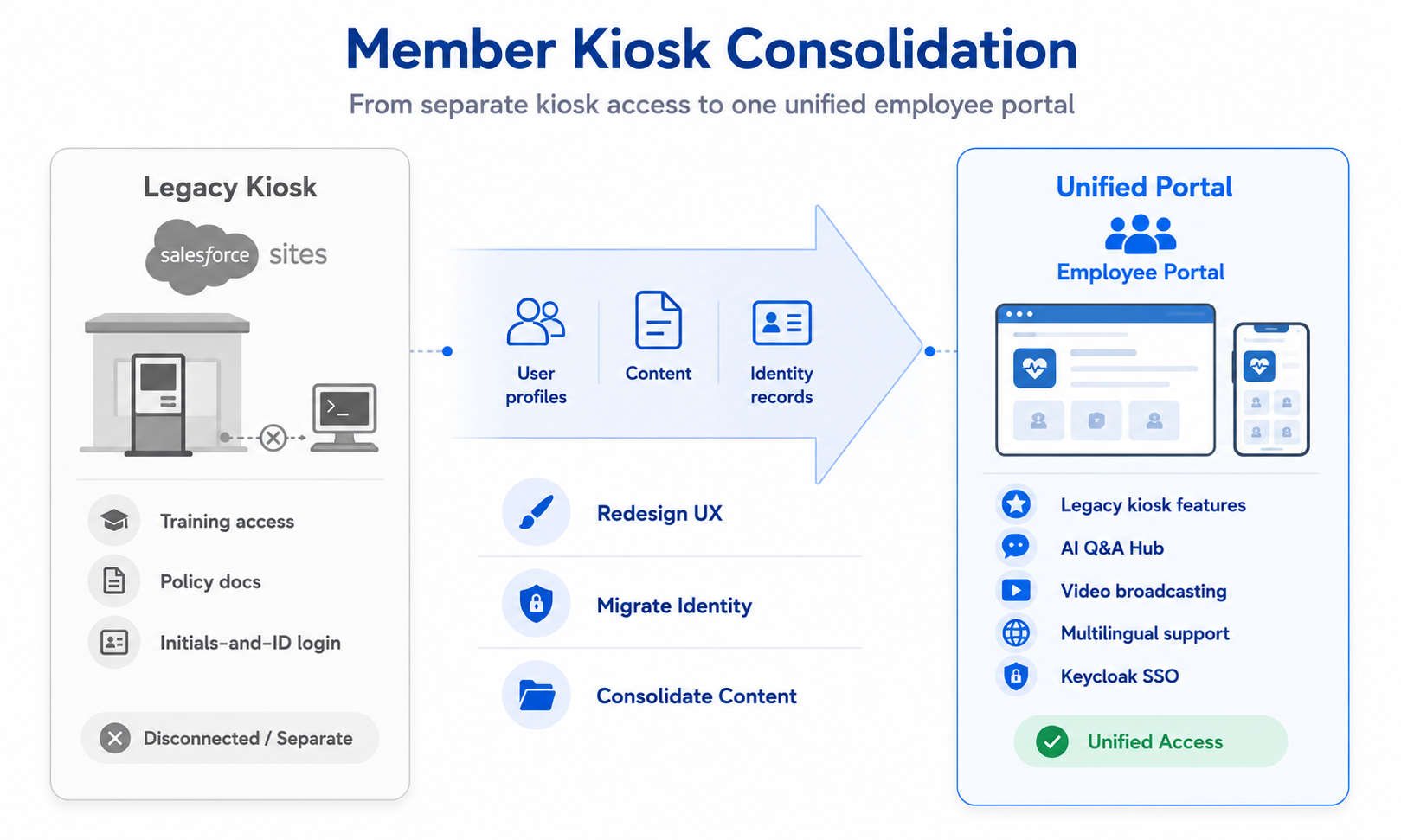
The Team Member Kiosk operated in a separate Salesforce Sites environment, creating a disconnected employee experience. Frontline team members accessed training, policies, and workforce resources through a standalone platform with a different authentication model (initials-and-ID), limiting identity management capabilities. Maintaining multiple platforms increased operational complexity and support overhead. The shared-device and frontline worker needs were not fully aligned with the evolving Employee Portal strategy, resulting in fragmented experiences and duplicated infrastructure.
JBS Dev redesigned and rebuilt the Team Member Kiosk as a dedicated experience within the Employee Portal platform. Kiosk Experience Redesign: Simplified kiosk user interface optimized for frontline and shared-device usage, integration with existing Employee Portal platform services and components, kiosk-specific navigation and content access patterns while maintaining distinct kiosk identity, purpose-built for shared-device scenarios common in frontline environments. Content Consolidation: Access to training content already available within the Employee Portal and Workday, policy content surfaced through the Employee Portal Knowledge Hub, leverages existing multilingual capabilities (English and Spanish) from the main portal, no duplication of content management—single source of truth. Identity Integration: Onboarding frontline kiosk users into Keycloak as non-email users, retirement of legacy initials-and-ID access model, integration with Employee Portal identity framework, consistent identity management across all employee populations. Migration & Transition: User Acceptance Testing (UAT) support, production deployment and cutover planning, coordination of kiosk transition activities, documented decommission plan for legacy Salesforce Sites environment.
✓ Solved Finding #6: Fragmented Frontline Access Created Maintenance Overhead
Cumulative Business Value
From fragmented workforce communications to unified AI-powered employee technology ecosystem serving 22,000+ non-desk healthcare workers.
Before: Fragmented Systems and Manual Processes
After: Unified AI-Powered Employee Technology Ecosystem
verified JBS Dev developed deep working knowledge of distributed healthcare workforce technology, non-desk employee onboarding, multilingual content delivery, AI-powered knowledge management, and agentic support automation—reducing learning curve for each subsequent project phase and enabling rapid response to evolving operational needs.
What Made This Work
Solved for Non-Desk Workers Without Email
JBS Dev designed custom identity workflows for employees without corporate email through Keycloak integration, account claim flows, shared-device support, and manager-assisted recovery. This enabled reaching 100% of the workforce, not just desk-based employees with email addresses. Traditional enterprise authentication systems assume email-based access—this platform proved that assumption could be safely bypassed through pragmatic architecture and operational workflows.
Automated Multilingual Content at Healthcare Scale
AWS Elemental MediaConvert, Amazon Transcribe, and Amazon Translate enabled automated video processing and subtitle generation for 5-8 languages without manual coordination. This wasn't a feature add—it was operationally critical for a workforce where Spanish, French, Creole, Somali, Tagalog, and Nepali speakers could not access English-only communications. Automated processing eliminated manual subtitle creation bottlenecks while ensuring accessibility and compliance.
RAG Architecture Reduced Support Ticket Volume
AI-powered Q&A Hub using AWS Bedrock Knowledge Bases and two-agent RAG architecture provided instant, source-grounded answers to policy and procedure questions. Rather than generating support tickets for routine questions, employees accessed accurate information with full source attribution. The verification agent ensured answers addressed the actual question, and inline document playback enabled employees to review source material directly within the chat interface.
Reusable Agentic Automation Framework
Rather than building one-off automations for each support workflow, JBS Dev designed a foundational platform with reusable integration patterns, business rules engine, and human-in-the-loop controls. Initial Staples access automation validated the architecture. Success enabled rapid deployment of 22 additional automation use cases representing 36,842 tickets and 11,566 hands-on hours annually. The reusable foundation reduced implementation effort for each subsequent automation while maintaining governance and auditability.
Consolidated Infrastructure Reduced Operational Overhead
Rebuilding the Member Kiosk within the Employee Portal eliminated fragmented authentication, duplicate content management, and separate platform maintenance. Frontline employees gained immediate access to Employee Portal enhancements (AI Q&A Hub, multilingual video, improved content delivery) through unified infrastructure. Consolidation reduced licensing costs, simplified identity management, and eliminated operational complexity of maintaining parallel Salesforce Sites environment.
AWS Serverless Architecture Scaled with Business Growth
Serverless AWS architecture (Lambda, Aurora Serverless, S3, Bedrock, Elemental MediaConvert, Transcribe, Translate) charged only for actual usage rather than upfront infrastructure investment. Elastic scaling supported 30,000+ concurrent users without over-provisioning. Infrastructure-as-code via AWS CDK enabled multi-environment deployments (Dev/Stage/Prod) with consistent configuration. Costs scaled with business growth, not capacity planning, while maintaining enterprise security and compliance controls.